Driveway, Patio, and Walkway Moss in Seattle: The Slip Hazard, the Damage Underneath, and the Closing Window
Nobody books a driveway cleaning because the driveway looks bad. They book it because somebody went down on it.
Usually it is the same spot every time. A north-facing walkway, a shaded stretch beside the garage, the back patio under the firs. A thin dark film that reads as “wet concrete” right up until the moment someone puts weight on it at an angle.
That film is a living organism, it is one of the slipperiest surfaces you can walk on, and in this region it is at full strength from roughly October through May. Here is what it actually is, what it is doing to the surface underneath, and why the window for dealing with it properly is closing right now.
It is not dirt, and that is why hosing it off does nothing
Three different things grow on Pacific Northwest hardscape, and they behave differently.
Algae is the black or dark green film. It is what makes a walkway treacherous. It holds a layer of water against the surface and turns a textured broom-finish concrete into something with almost no effective grip. It is also the one people most often mistake for staining, because it looks flat and dirty rather than alive.
Moss is the cushion in the joints and at the edges. On pavers it colonizes the sand-filled joints. On concrete it works into control joints, expansion gaps, and the seam where the slab meets a planting bed.
Lichen is the flat gray or pale green crust that looks painted on. It is the stubborn one. Lichen bonds chemically to the surface rather than sitting on it, and it will not come off with pressure alone at any safe setting.
All three need the same three things: moisture, shade, and a textured surface to hold onto. A north-facing concrete walkway under a Douglas fir in Bothell is close to a purpose-built habitat. This is why the problem is not evenly distributed across a property. The south-facing driveway apron can look fine while the side path to the back gate is a hazard, and both get cleaned at the same interval by anyone paying attention.
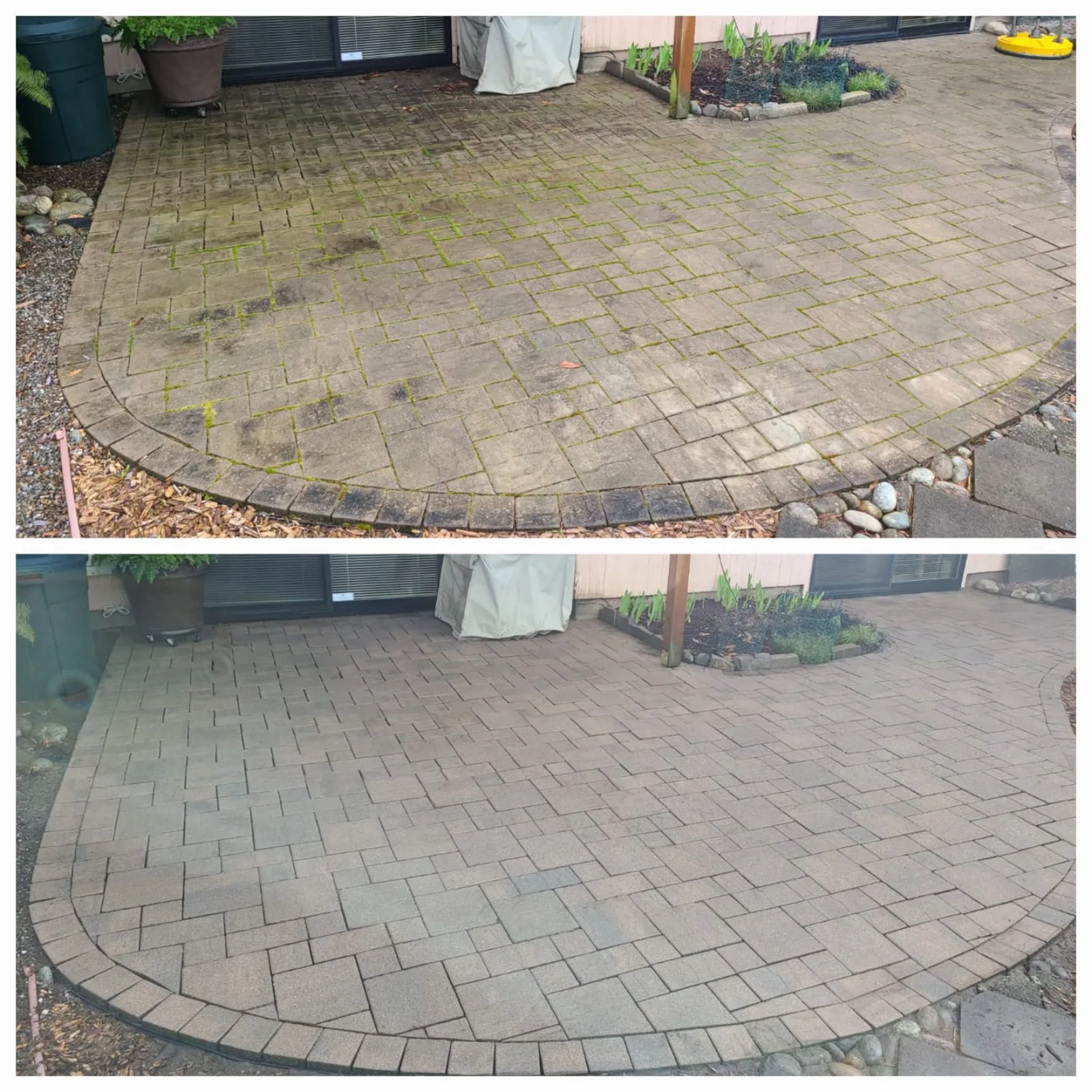
Why moss in paver joints is a structural problem
On a poured concrete slab, growth is mostly a surface and safety issue. On pavers it is not.
An interlocking paver surface is not held together by the pavers. It is held together by the sand in the joints between them. That sand is what transfers load sideways from one paver to its neighbors, which is what stops individual units from rocking, tilting, and settling out of plane.
Moss displaces that sand. The root mass grows into the joint, pushes sand out over time, and holds water where sand used to be. Once enough joints are compromised you get the familiar sequence: a few pavers start to rock underfoot, water begins finding its way into the bedding layer instead of running off the top, the base starts to wash and settle, and what was a cleaning job becomes a lifting and re-laying job.
That is why a proper paver service is not just a wash. The joints get re-sanded with polymeric sand after cleaning, which locks back up when wetted and resists regrowth far better than plain sand. Skipping the re-sand is the single most common corner cut in this trade, and it is the one that guarantees you are back in the same position in two seasons.
They were almost certainly cleaned without being re-sanded, or sealed over joints that were still open. An empty joint is a seed bed with water in it. The regrowth is not bad luck, it is a missing step.
Autumn adds a second problem: tannin staining
There is a reason we push people to get this done before the leaves finish dropping rather than after.
Leaf and needle litter left sitting on concrete through a wet stretch leaches tannins into the surface. On light concrete that shows up as brown or rust-colored blotches in the exact shape of the leaves that sat there, and it is not surface dirt. It has soaked into the top layer of a porous material.
Tannin staining removed within a few weeks usually comes out cleanly. Tannin staining that has sat on an unsealed slab through an entire Pacific Northwest winter often does not come out completely at all, and what is left needs a dedicated treatment rather than a wash.
The practical version: the pile of fir needles in the corner of the patio is not a cosmetic nuisance, it is a stain with a timer on it.

The method matters more on concrete than people expect
Concrete looks indestructible, which is why more concrete gets permanently damaged by pressure washing than any other exterior surface.
The damage mode is not cracking. It is erosion of the cement paste at the surface, which exposes the aggregate underneath and leaves the slab permanently rougher, lighter, and far quicker to re-soil. There are two ways homeowners and inexperienced operators produce it.
Wand marks. Using a narrow tip on a handheld wand, a slab gets cleaned in overlapping arcs. Where the arcs overlap, the surface gets cleaned twice. Where they do not, it does not. The result is a permanent striped pattern, sometimes called zebra striping, that is visible on the slab long after the moss is gone. It cannot be fixed by cleaning it again, because the problem is that the surface itself is no longer uniform.
Dwelling in one place. Holding a tip too close or too long etches a visible mark into the paste, which again is permanent.
The correct tool is a surface cleaner: a rotating bar enclosed in a housing that keeps the tips at a fixed height and a fixed distance, moving at a consistent speed across the whole slab. It cleans edge to edge at a uniform intensity, which is the entire point. Pressure then gets dialed to the surface rather than to the toughest spot on it.
On pavers the setting goes down further still, because too much pressure strips the joint sand out faster than moss ever would, and on older colored pavers it can lift the pigmented face layer.
And for lichen and heavy algae, pressure is not what removes it anyway. A cleaning solution applied first, given time to work, is what kills the organism. The water is there to rinse away what the chemistry already killed. Operators who skip the dwell time compensate with pressure, and that is how surfaces get wrecked.
| Surface | Correct approach | What goes wrong otherwise |
|---|---|---|
| Broom-finish concrete | ✓ Surface cleaner, treated first | Wand arcs leave permanent zebra striping |
| Exposed aggregate | ! Lower pressure, more dwell | Pressure dislodges the decorative stone itself |
| Stamped or colored concrete | ! Low pressure, reseal after | The color layer and old sealer strip unevenly |
| Interlocking pavers | ✓ Clean, re-sand, then seal | Joint sand blows out and the surface destabilizes |
| Natural stone and flagstone | ! Gentlest setting, by hand at edges | Soft stone erodes and mortar joints fail |
| Any hardscape | ✕ Never a narrow tip up close | Etching is permanent on every one of these |
The timing, and why we are blunt about October
Cleaning can be done in the rain. Sealing cannot.
Sealers need a dry, cured surface and temperatures above roughly 50°F, with a dry window after application for the product to set. Those two conditions stop reliably co-occurring in the Seattle area somewhere in the back half of October, which is what makes this a genuinely time-boxed decision rather than a sales line.
Here is the shape of it:
So the honest guidance splits in two.
If you want it cleaned and sealed, this month is the call. Sealed concrete and sealed pavers resist water intrusion, oil absorption, and biological growth through the wet season instead of absorbing all three. Going into November sealed is the difference between a surface that needs a rinse in spring and one that needs the whole job again.
If the window has already closed where you are, clean it anyway. A clean, unsealed slab going into winter is still far better than a mossy one. It is safer to walk on, it will not have tannin staining setting into it, and the organic load that would otherwise feed next spring’s growth is gone. Seal it in the spring when the weather turns. Anyone who tells you a sealer will cure fine on a damp November slab is going to come back and do it again at your expense.
Free assessment, written and itemized. We will tell you honestly whether the sealing window is still open for your surface or whether you are better off cleaning now and sealing in spring.
On doing it yourself
Some of this is reasonable to take on. Some of it is how surfaces get ruined.
Reasonable: keeping leaf and needle litter cleared off the hardscape through autumn, which is most of the battle and costs nothing. Rinsing a small patio. Pulling moss out of the odd joint by hand.
Where it goes wrong:
Renting the biggest machine available. Pressure is the variable people reach for and the one that causes the damage. A rented 4,000 PSI unit with a narrow tip and no surface cleaner is the exact recipe for zebra striping a driveway.
Bleach straight onto the surface. Undiluted bleach poured on concrete will take the algae off and will also kill whatever it runs into downhill. Planting beds, lawn edges, and the roots of anything adjacent are all downhill from a sloped driveway. Professional work involves pre-wetting surrounding vegetation and rinsing it afterwards for exactly this reason.
Sealing over a surface that is not fully clean or fully dry. Sealer locks in whatever is underneath it. Seal over live algae or trapped moisture and you get a cloudy, blotchy finish with the organism still growing beneath it, and stripping a failed sealer is a much worse job than the one you were trying to avoid.
Keep the shaded hardscape swept through October and November. The organic litter is what feeds the growth. Removing it does not fix an established colony, but it slows the next one down more than any product you can buy.
If you own or manage a commercial property
The calculus changes when the walkway is not yours.
Algae on a customer walkway, a restaurant patio, an apartment breezeway, or an office entry is a documented slip and fall exposure, and the weather it is most dangerous in is the weather you are about to get for six months. The surfaces that matter most are the ones nobody looks at: the side entry, the path from the back lot, the shaded stretch of sidewalk along the north wall.
Property managers in our service area generally handle this with scheduled cleaning rather than reactive calls, for the straightforward reason that a scheduled visit is cheaper than an incident. Same logic for homeowners with aging parents or small children using a shaded path daily.
What to ask before you hire
- Will you use a surface cleaner on the flat work, or a wand? If the answer is a wand, you are buying stripes.
- Do you pre-treat and let it dwell, or go straight to pressure? Pressure alone does not kill lichen or algae roots. It just relocates the problem.
- For pavers, is re-sanding included? It should be. Cleaning pavers without re-sanding the joints is half a job that undoes itself.
- What do you do about the landscaping? Pre-wet and rinse is the correct answer.
- Is sealing still viable this late, honestly? A contractor willing to tell you no in October is the one to use in March.
Working with Homefront
We clean and seal concrete, pavers, patios, and walkways across Seattle, Bellevue, Kirkland, Redmond, Sammamish, Bothell, Kenmore, Woodinville, and the wider Eastside, matching the method and the pressure to the surface rather than running everything at the same setting.
If you are not sure whether what you are looking at is staining or growth, or whether sealing still makes sense this year, send a photo and we will tell you straight. Request a free quote or call (425) 298-7041.
Ready to Transform Your Property?
Get a free, no-obligation power washing quote from Seattle's #1 rated team.