Roof Moss Removal Seattle | Soft Wash Treatment, Not Pressure | HPW
Every autumn we get the same call. A homeowner has looked up from the driveway for the first time in a year, noticed the north slope of the roof has gone green, and wants to know whether it is a problem or just how roofs look here.
It is a problem. And in this region it is the single most expensive maintenance item people put off, because the damage is slow, invisible from the ground, and already done by the time anyone notices a leak.
Here is what is actually happening up there, and what can and cannot be done about it.
Moss does mechanical damage, not cosmetic damage
The green you can see is the smallest part of it.
Moss is a shallow-rooted plant, and on an asphalt shingle roof it does not root into the shingle itself. It roots into the gap. It establishes in the horizontal seam where one course of shingles overlaps the one below, and as the colony thickens it physically wedges that seam open.
That matters for three separate reasons.
It breaks the seal. Asphalt shingles are designed to lie flat and bond to the course below with a sealant strip. A lifted shingle has lost that bond, which is what keeps wind-driven rain from being pushed up and under. In a region with winter storms arriving off the water, a roof full of lifted shingle edges is a roof with a hundred small entry points.
It holds water against the deck. Moss is extremely good at retaining moisture. A roof that would normally shed a rain event and dry out instead stays saturated under every moss colony, right through the wet season. Sustained moisture against the underside of a shingle and the sheathing beneath it is how rot starts.
It takes granules with it. The colored granules on an asphalt shingle are not decoration. They are the UV shield that keeps the asphalt below from drying out and becoming brittle. Moss growing in and around the granule layer loosens it, and every removal method takes some granules with the moss. That is unavoidable. The goal is to take as few as possible, which is exactly where method matters.
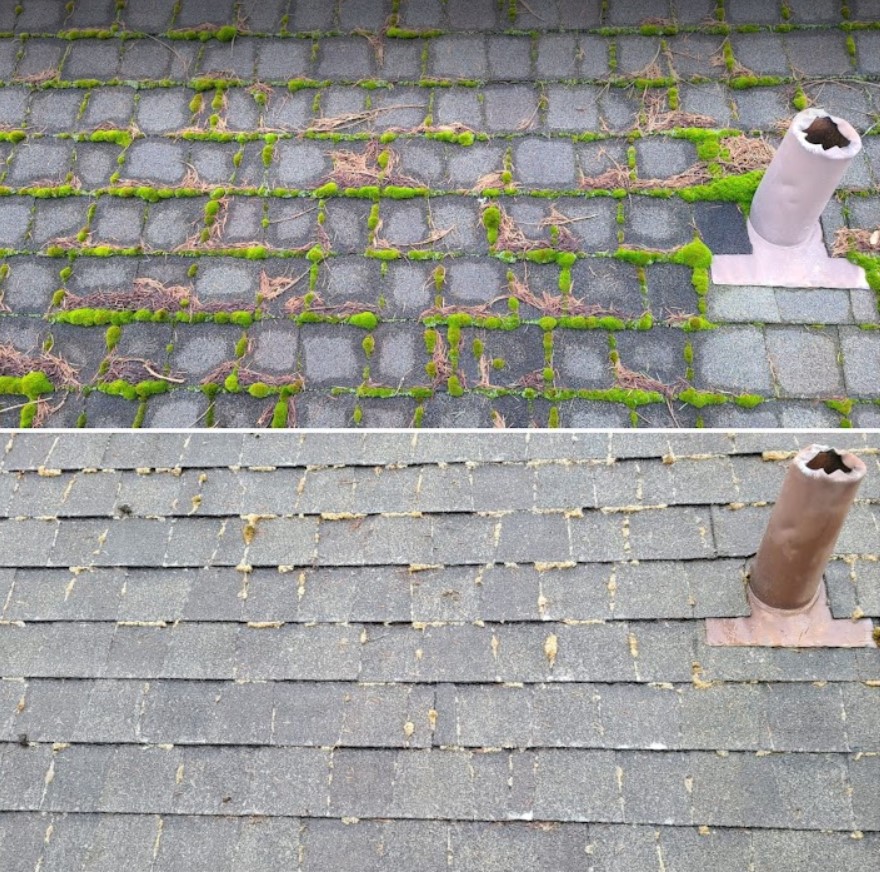
On cedar shake the mechanism is different and the outcome is worse. Moss and lichen bond into the grain of the shake rather than sitting in a seam, holding moisture directly against wood that is relying on being able to dry. Cedar roofs in heavy shade can lose years off their life to untreated growth.
Why you must not pressure wash a roof
This is the part worth being blunt about, because the mistake is common and it is not reversible.
High pressure strips the granule layer off asphalt shingles, taking the roof's UV protection with the moss, and drives water up under shingle courses and cedar shakes into the sheathing. Asphalt shingle manufacturers generally specify low-pressure cleaning, and pressure washing damage is commonly excluded from warranty coverage. A pressure washed roof usually looks dramatic on the day and fails years early.
The reason it keeps happening is that pressure washing a roof produces an incredible before and after photo. Green goes to clean in about twenty minutes. What the photo does not show is the granule sediment at the bottom of the downspout, which is the roof’s service life sitting in a gutter.
There is a second problem with the blast-it-off approach, and it is the one that brings people back in eighteen months. Knocking the visible moss off does not kill the organism. The root structure stays in the seam, and the colony regrows from it. Roofs that have been aggressively pressure washed frequently go green again faster than they did the first time, because the surface has been roughened and is now holding more moisture and debris than it used to.
How soft wash moss treatment actually works
The professional method is slower, less dramatic to watch, and the roof is still intact afterwards.
1. Debris clearing first. Needles, branches, and leaf litter come off the roof and out of the valleys and gutters before anything else happens. In this region that layer is usually substantial, and it is what feeds the moss. Treating a roof without clearing it first is treating the debris, not the roof.
2. Treatment applied at low pressure. A cleaning solution is applied across the affected slopes at a pressure comparable to a garden hose. The solution kills the moss, algae, and lichen at the root rather than knocking the top off it.
3. Dwell time. The chemistry needs contact time. This is the step contractors in a hurry skip, and it is the difference between killing the colony and bleaching it.
4. Gentle removal of the dead growth. Dead moss releases on its own. Heavy accumulations get cleared by hand or with a soft brush, with the slope worked downward so nothing is driven under a shingle course. The rest weathers off over the following weeks.
5. Rinse down and clean-up. Surrounding siding, gutters, walkways, and plantings get rinsed. Vegetation adjacent to the work is pre-wetted before any solution goes on, which dilutes incidental overspray rather than letting it absorb.
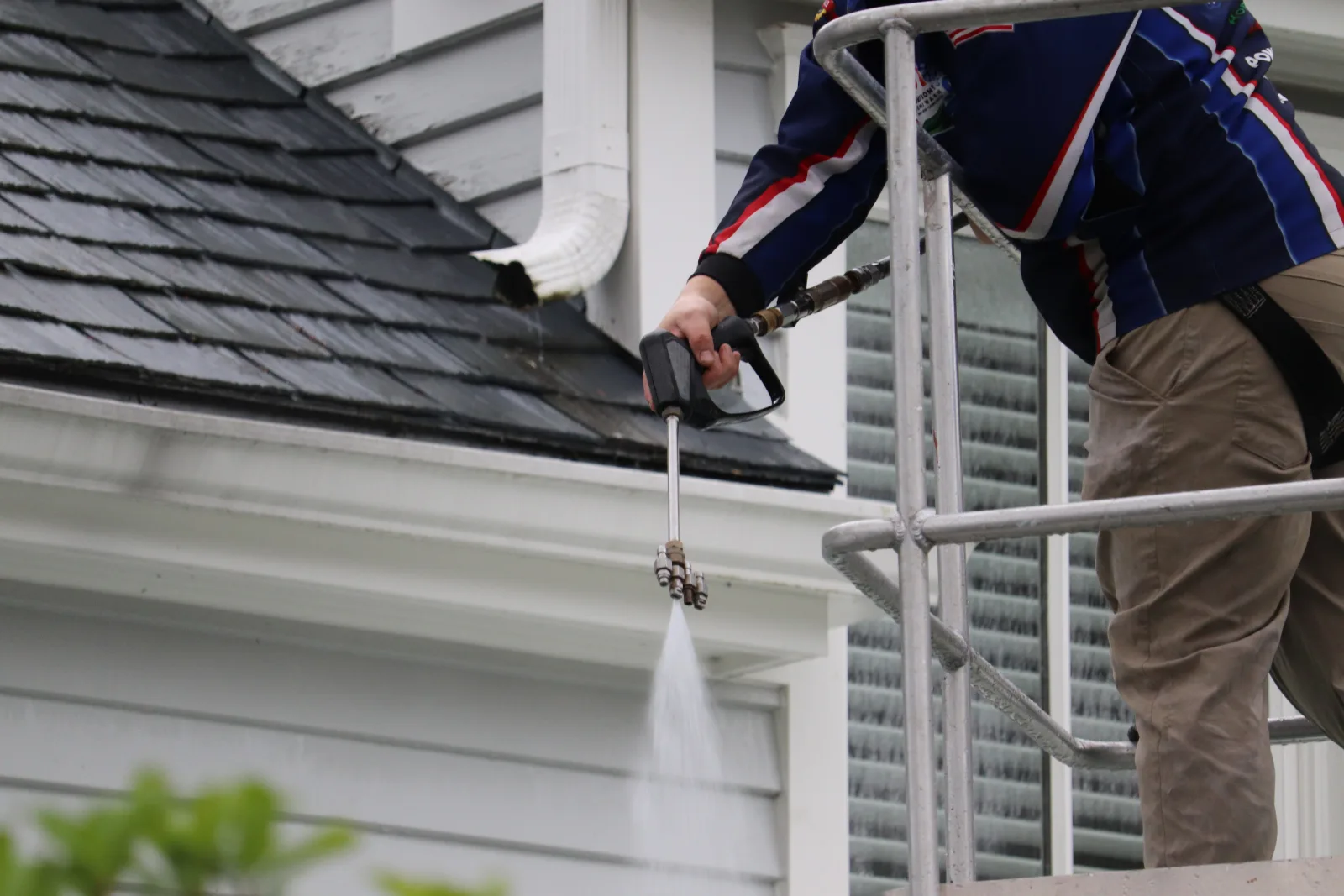
If you look at a roof two weeks after a proper soft wash, there will still be some gray residue weathering off. That is normal and it is the trade-off: a roof that looks completely bare on the afternoon of service was almost certainly cleaned with force.
Method by roof type
| Roof surface | Correct method | What goes wrong otherwise |
|---|---|---|
| Asphalt / architectural shingle | ✓ Soft wash | Pressure strips granules and voids most warranty coverage |
| Cedar shake | ✓ Soft wash | Pressure drives water under the shakes and raises the grain |
| Concrete or clay tile | ! Low pressure, with care | Tiles are walkable only in specific places and crack underfoot |
| Metal roofing | ! Low pressure, with care | Panels dent and coatings scratch; seams and fasteners need attention |
| Composite / synthetic shake | ✓ Soft wash | Manufacturer warranties commonly set explicit pressure limits |
| Any roof, any material | ✕ Never high pressure | There is no roof surface where high pressure is the right answer |
What zinc and copper strips do, and what they do not
This comes up on almost every roof quote, so it is worth being precise.
Zinc or copper strips installed near the ridge release small amounts of metal ions into rainwater as it runs down the slope, and those ions inhibit new moss and algae growth. The effect is real.
It is also limited in two specific ways that get oversold.
They do not remove existing growth. A strip installed on a mossy roof does essentially nothing to the moss already there. Treatment comes first; the strip is a maintenance measure afterwards.
The effect weakens with distance. The protection is strongest in the first several feet below the strip and tapers off further down the slope. On a tall or complex roof, a single ridge strip does not protect the whole surface, which is why they are best understood as something that lengthens the interval between treatments rather than replacing them.
Zinc strips are a reasonable add-on after a treatment if your roof is heavily shaded. They are not a substitute for treatment, and anyone selling them as one is selling you a slower version of the same problem.
Timing: why October is the right call
Moss in the Pacific Northwest grows hardest in the cool, wet, low-light months. It is largely dormant in a dry August and actively expanding from late autumn through spring.
That makes the practical calendar fairly simple:
- September to November. The best window. Treating before the heavy growth season means the colony goes into winter dead rather than expanding, and the debris that feeds it comes off the roof at the same time as the gutters get cleared.
- December to February. Workable on dry days, but scheduling is weather-dependent and the growth has already had a run at the roof.
- March to May. The second-best window. Catches the spring flush and sets the roof up for summer.
- June to August. Fine, and often the easiest to schedule, though solution evaporates faster in dry heat and the work needs to be timed to cooler parts of the day.
The one timing rule that is not negotiable: if you can already see moss lifting shingle edges, the correct time is now rather than at the next convenient season. Lifted shingles and winter storms are a bad combination.
Free assessment, written and itemized. If your roof does not need treatment yet, we will tell you that instead.
Gutters are part of the same job
Roof moss and gutter debris are one problem wearing two hats.
The needle and leaf layer that collects in a gutter is the same material that collects in the roof valleys and feeds the moss colonies. Clearing one without the other means the roof reseeds itself from the material you left in place, and moss growing in a gutter trough blocks flow just as effectively as leaf litter does.
Booking them together is also simply cheaper, because the access setup is the expensive part of both jobs and it only has to happen once.
What to ask before you hire
Four questions will tell you most of what you need to know.
- Do you soft wash roofs, or pressure wash them? If the answer involves PSI, keep calling.
- Is debris clearing included, or extra? It should be included. A treatment over an uncleared roof is half a job.
- What do you do about the landscaping below? The correct answer involves pre-wetting and rinsing, not “it’s fine.”
- Are you licensed and insured, and can you send a certificate? Roof work is height work. Any hesitation here is your answer.
A wet, moss-covered roof in a Pacific Northwest autumn is one of the most treacherous surfaces you will ever stand on, and ladder falls during home maintenance are a significant source of serious injury every year. Moss makes a roof slippery in a way that is genuinely hard to anticipate from the ground. If you take nothing else from this, take that.
Working with Homefront
We treat roof moss across Seattle, Bellevue, Kirkland, Redmond, Sammamish, Bothell, Kenmore, and the wider Eastside, using soft wash on every roof surface and clearing debris and gutters as part of the same visit rather than as an upsell.
If you are not sure whether what you are looking at needs treatment now or can wait a season, send us a couple of photos from the ground and we will tell you honestly. Request a free quote or call (425) 298-7041.
Ready to Transform Your Property?
Get a free, no-obligation power washing quote from Seattle's #1 rated team.