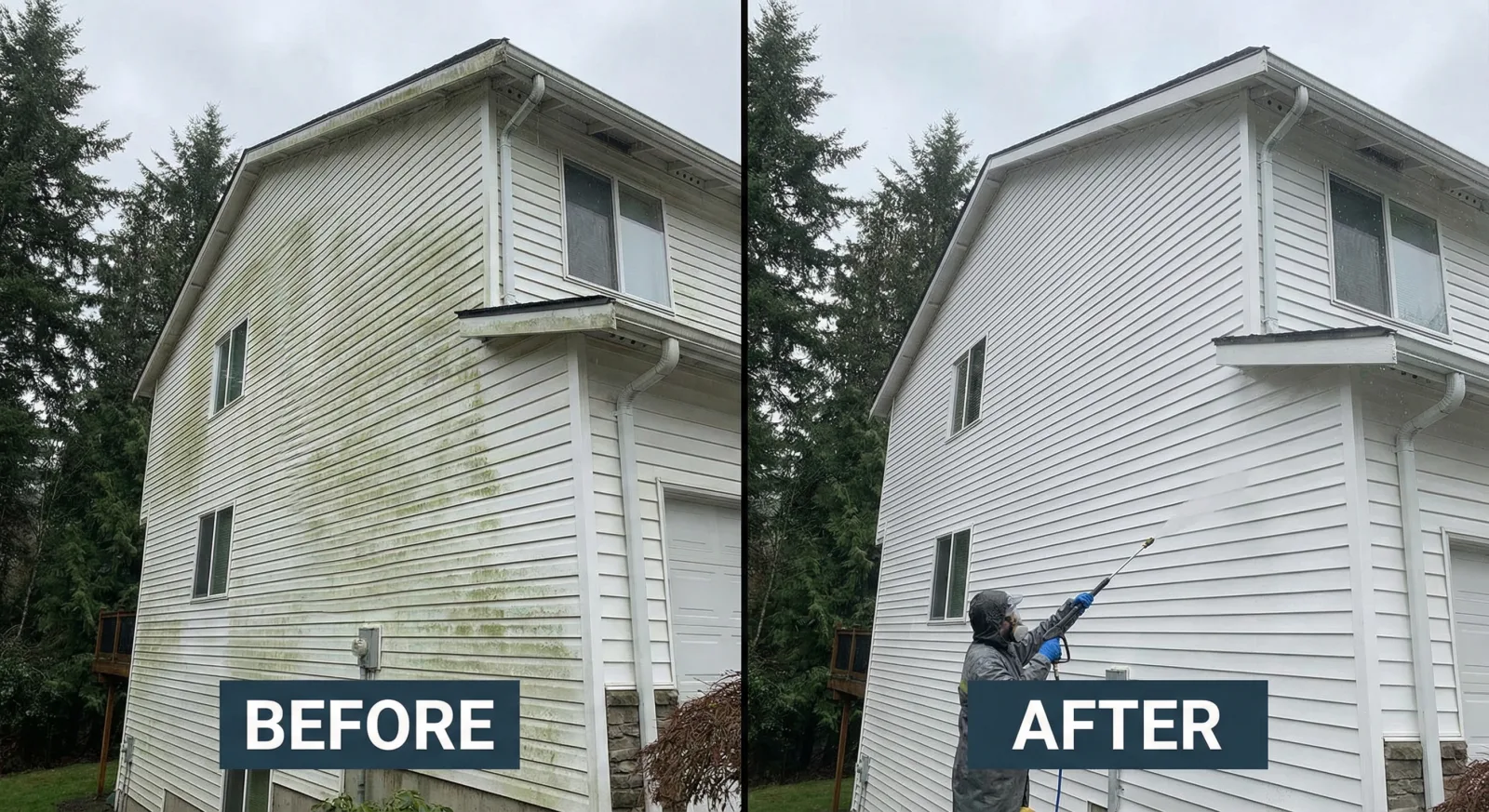
Unveiling the Art of Power Washing Excellence
Two crews can clean the same driveway on the same afternoon and produce results that look identical when the water dries. Six months later, one of them still looks clean and the other has gone green again at the edges.
The difference isn’t effort, and it usually isn’t equipment. It’s technique — a set of decisions made before the trigger is ever pulled. Here’s what actually separates an excellent exterior cleaning job from an adequate one.
PSI Is the Wrong Number to Care About
Ask most homeowners what makes a pressure washer powerful and they’ll say PSI. Ask a professional and they’ll say flow rate.
PSI — pounds per square inch — measures the force concentrated at the nozzle. GPM — gallons per minute — measures how much water is moving through the system. Cleaning is mostly the second one.
Here’s why. PSI dislodges material. GPM carries it away and keeps the surface saturated so cleaning solution stays active. A consumer unit from a hardware store might advertise 2,000 PSI at 1.4 GPM. A professional rig runs 3,000–4,000 PSI at 4–8 GPM. That’s not twice the machine — it’s four to six times the water moving across the surface per minute.
The practical result is counterintuitive: the professional machine usually cleans at lower pressure, because it doesn’t need force to compensate for inadequate flow. The homeowner with the 1.4 GPM unit ends up pressing the wand closer to the concrete to get results, which is exactly how you etch tiger stripes into a driveway.
More water, less force. That’s the whole principle.
The two charts below are the same two machines, measured twice. On pressure they look close. On water moved per minute they are not in the same category.
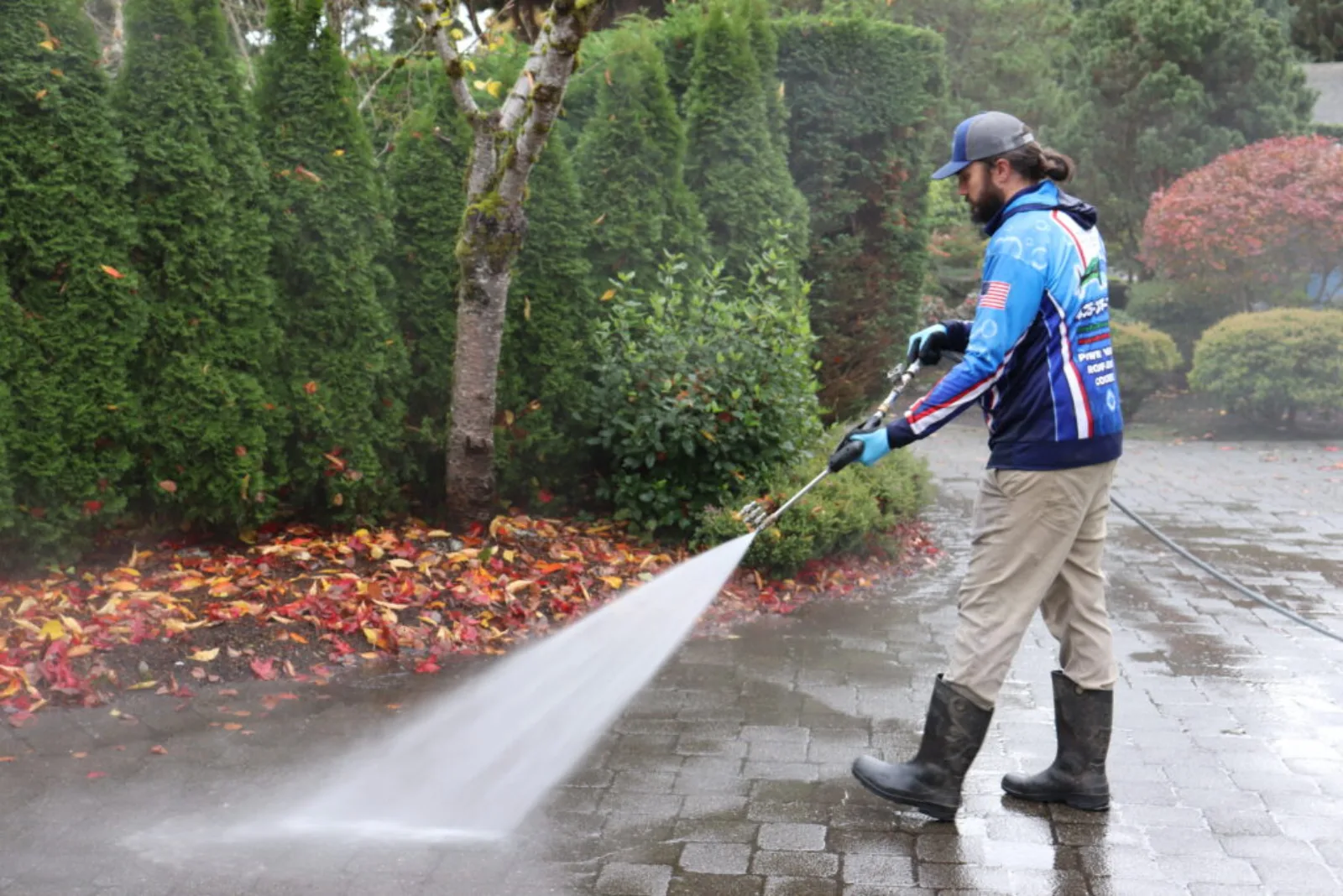
Chemistry Does the Work; Water Removes the Evidence
The most common misconception in exterior cleaning is that pressure cleans. On most surfaces, it doesn’t — it just strips.
Organic growth in the Pacific Northwest isn’t sitting on top of your siding. Moss, algae, and lichen have root structures that penetrate the surface. Blasting the visible green off a roof leaves the root system in place, which is why aggressively pressure-washed roofs go green again within a season, often faster than before.
Professional soft washing applies a cleaning solution, lets it dwell, and allows the chemistry to kill the organism at the root. The rinse afterward is low pressure because it isn’t doing the cleaning — it’s just removing what’s already dead.
Three things determine whether that works:
- Concentration. Too weak and the organism survives; too strong and you damage the substrate or the surrounding landscaping.
- Dwell time. Solution needs contact time to work, and it varies by surface, growth type, and ambient temperature. Rinsing too early is the single most common way a soft wash under-performs.
- Ambient conditions. On a hot, dry, breezy day, solution evaporates before it finishes working. Overcast and cool — which is most of the year here — is genuinely better cleaning weather.
That last point is why an experienced crew will sometimes reschedule a job that could technically be done that day.
Surface Sequencing: Top-Down, Always
There’s an order to a full exterior clean, and getting it wrong means doing work twice.
Roof first, then upper siding, then lower siding, then hardscape. Gravity is not optional. Cleaning a driveway before soft-washing the roof above it means the roof runoff carries dead organic material straight down onto freshly cleaned concrete.
It sounds obvious. It gets skipped constantly on jobs quoted by the hour, because the driveway is the fastest visible win and finishing there makes the departure look impressive.
Sequencing also matters within a single surface. On siding, working bottom-to-top during application and top-to-bottom during rinse prevents the streaking that happens when cleaning solution runs down over dry, dirty material and dries in place before you reach it.
Prep Is Half the Job
The work that happens before any water is turned on:
Vegetation protection. Landscaping adjacent to the work area gets thoroughly pre-wetted and, where necessary, covered. Wet foliage dilutes any incidental overspray rather than absorbing it. This is not optional near Puget Sound, where runoff management is both an environmental and a regulatory concern.
Entry point inspection. Windows, vents, light fixtures, outlets, and any gaps in siding get identified before the wash. Water driven into a soffit vent at 3,000 PSI ends up in the attic.
Surface assessment. Cedar shake behaves differently than composite. Painted wood siding that’s already chalking will chalk further no matter how gentle the method, and the homeowner should hear that before we start, not after. Old, brittle, or previously damaged surfaces sometimes shouldn’t be cleaned at all.
Test patch. On anything unusual or uncertain, an inconspicuous test area first. This costs ten minutes and prevents the kind of mistake you can’t undo.
Matching Method to Surface
The single decision that most determines outcome:
| Surface | Method | Why |
|---|---|---|
| Asphalt shingle roof | ✕ Soft wash only | Pressure strips protective granules and voids warranties |
| Cedar shake roof | ✕ Soft wash only | Pressure drives water under shakes and raises grain |
| Vinyl siding | ✓ Soft wash | Pressure forces water behind panels into the wall assembly |
| Painted wood siding | ✓ Soft wash | Pressure accelerates paint failure and chalking |
| Stucco / EIFS | ✕ Soft wash only | Pressure damages the finish coat, and repairs are expensive |
| Concrete driveway | ✓ Surface cleaner | Flat-surface attachment prevents wand striping |
| Brick & stone | ! Moderate pressure | Aggressive pressure erodes mortar joints |
| Wood decking | ! Low pressure, with grain | High pressure raises and furs the wood fiber |
| Composite decking | ! Low pressure | Manufacturer warranties commonly specify limits |
The surface cleaner attachment for concrete deserves a specific mention. It’s a rotating bar assembly inside a housing that keeps the nozzles at a fixed height and constant speed across the surface. That geometric consistency is what produces an evenly cleaned driveway rather than the wand-arc pattern that shows up in low-angle sunlight for years afterward.
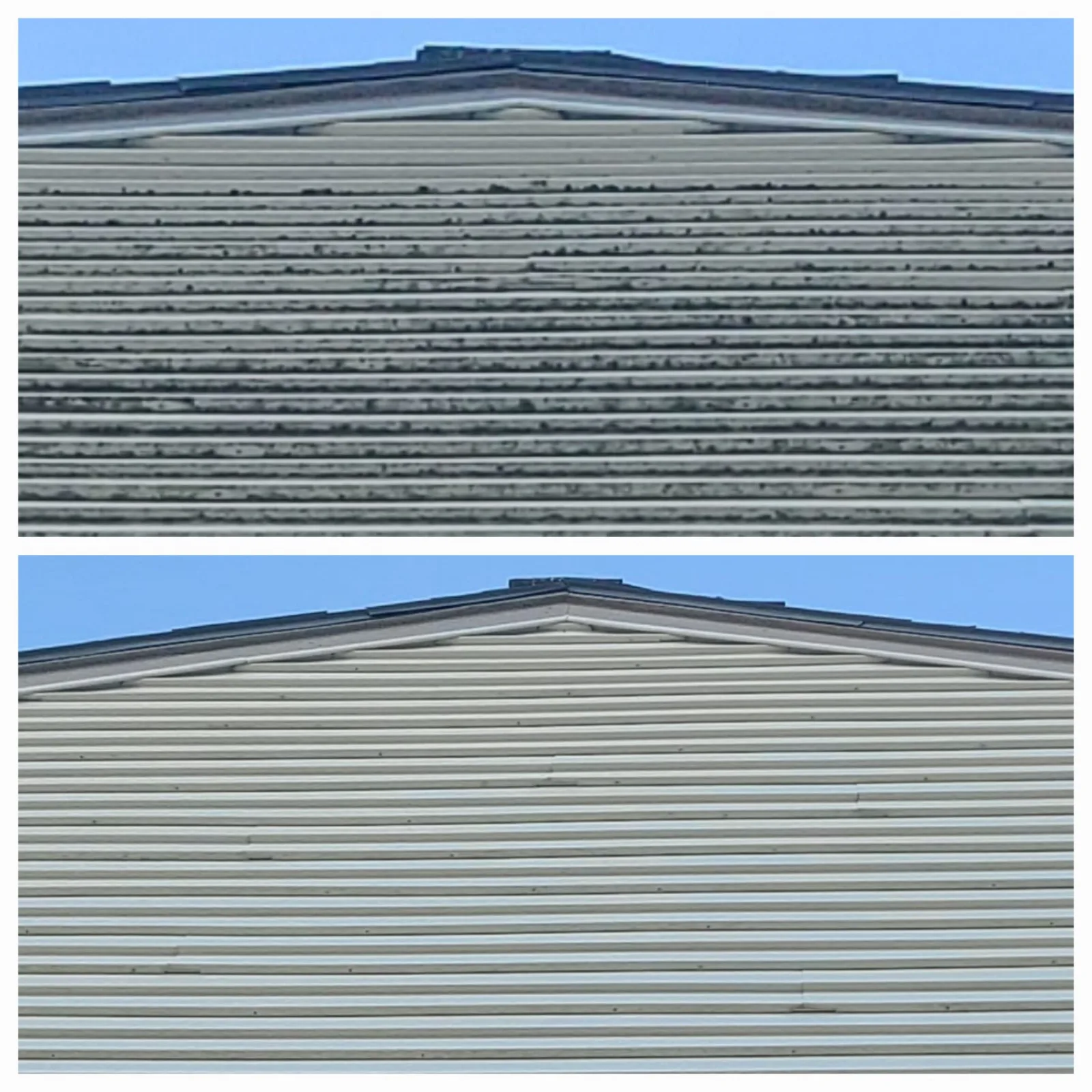
Written and itemized by surface, with the method for each one named up front. If cleaning will not help, we will say so.
What Excellence Actually Looks Like
It looks like nothing. That’s the point.
A great exterior cleaning job doesn’t announce itself with dramatic contrast — it produces a surface that looks uniformly correct, with no striping, no zebra patterns on the roof, no chalked patches on the siding, no damaged mortar, no dead shrubs along the foundation line. And it still looks that way in two years, because the growth was killed rather than knocked back.
The unglamorous truth of this trade is that the skill is mostly in restraint: knowing how much force not to use, and being willing to spend the extra twenty minutes on dwell time when the surface would look nearly the same if you rinsed early.
That’s the standard we hold across Seattle, Bellevue, Kirkland, Redmond, Sammamish, Bothell, and the surrounding communities — 3,000-plus properties in, and it hasn’t changed.
Want an honest assessment of what your property actually needs? Request a free quote or call (425) 298-7041. If cleaning won’t help, we’ll tell you that too.
Ready to Transform Your Property?
Get a free, no-obligation power washing quote from Seattle's #1 rated team.