Wood Restoration in the Pacific Northwest: Decks, Fences, and Patio Furniture
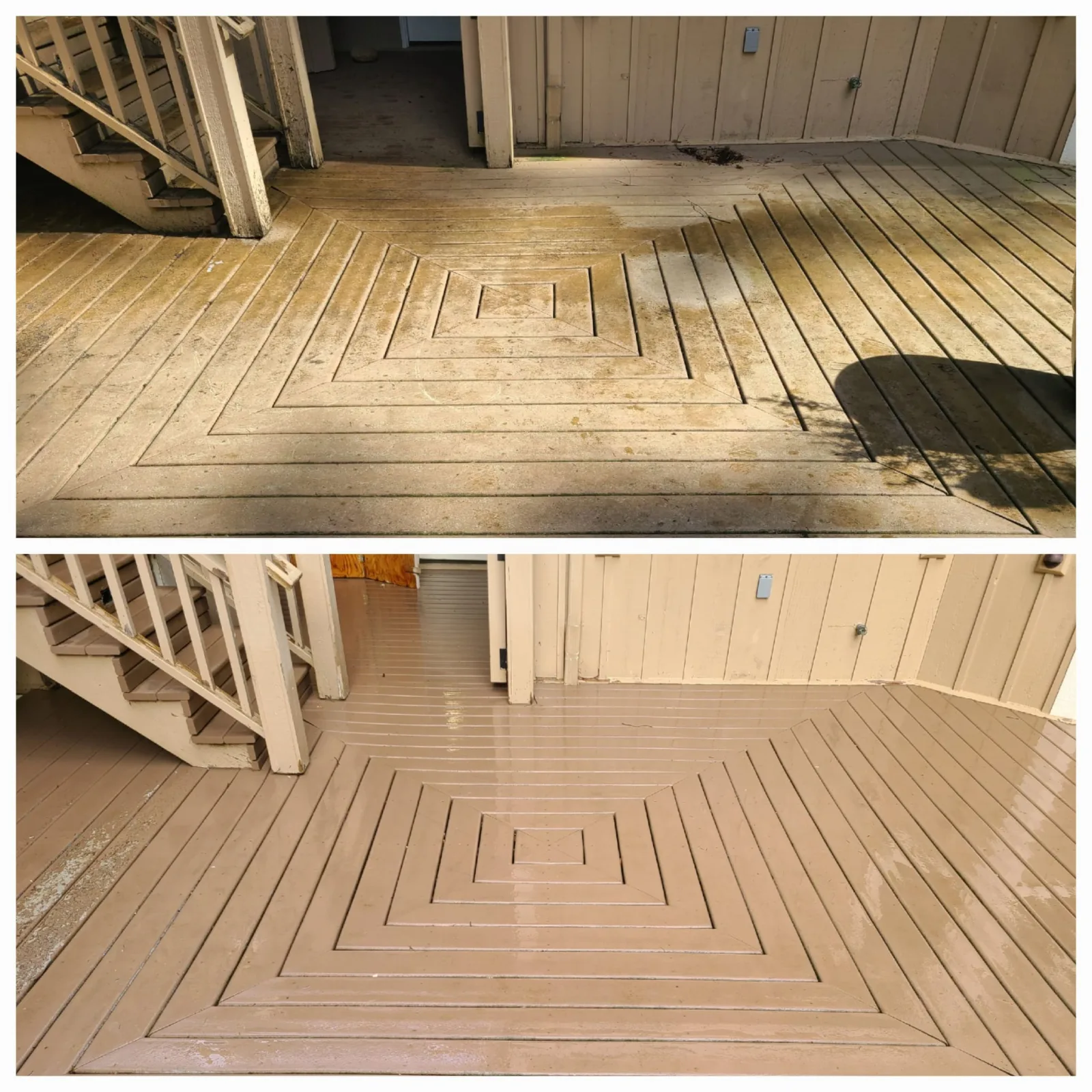
There is a particular look that Pacific Northwest wood gets after a few unprotected winters. Silver-gray on the exposed faces, black streaking where water sits, green in the shaded sections, and a fuzzy texture that snags a bare foot. Most homeowners assume the wood is simply old and due for replacement.
Usually it is not. Most of what you are looking at lives in the top fraction of a millimeter, and underneath is sound wood that will look close to new once the damaged surface layer and the organic growth are gone.
What ruins that outcome, more often than weather does, is a well-intentioned Saturday with a rented pressure washer.
Why pressure alone destroys wood
Softwoods like cedar, fir, and pressure-treated pine are not uniform. They grow in alternating bands: earlywood, formed in spring, which is soft and porous, and latewood, formed later in the season, which is dense and hard. You can see the alternation as the grain pattern.
When you point a 3,000 PSI wand at that surface, the pressure does not remove material evenly. It excavates the soft earlywood and leaves the hard latewood standing. That is what produces the washboard texture and the raised, splintery fuzz people call furring. It is mechanical damage, it is permanent, and no amount of sealer hides it. Sanding it out means removing enough material to get back below the damage.
The second failure mode is the wand mark. Concentrated pressure held too long or moved inconsistently leaves visible stripes and gouges that become permanent once stain goes over them.
The third is subtler and more expensive. Blasting open the wood fiber increases the surface area and the porosity, which means the wood absorbs and holds more water afterward. A pressure-damaged deck rots faster than one that was never cleaned at all.
Proper wood restoration uses low pressure. The cleaning is done by chemistry and dwell time, and the pressure washer is there mostly to rinse. If someone quotes you a deck job and talks about how much PSI their machine puts out, that is a warning sign rather than a selling point.
The two-step process, and why the second step is not optional
Wood restoration is a chemistry problem with two stages that move the pH in opposite directions.
Step one: the cleaner. An alkaline cleaner, typically based on sodium hydroxide or sodium percarbonate, does the heavy work. It breaks down the gray oxidized surface layer, kills and releases moss, algae, and mildew, lifts embedded dirt, and strips failing remnants of old sealer. On a neglected PNW fence, this step alone is dramatic.
But it leaves the wood in an alkaline state, and that causes two problems. Alkaline wood darkens, so the surface looks blotchy and dull rather than clean. And sealers and stains are formulated to bond to wood in a roughly neutral to slightly acidic pH range. Applied over alkaline wood, they adhere poorly and fail early.
Step two: the brightener. An acidic brightener, usually oxalic acid based, neutralizes the cleaner and drops the pH back into the right range. It also does something the cleaner cannot: it removes tannin staining and the black iron stains that bleed out around nails, screws, and hardware. This is the step that restores actual color rather than just removing dirt. Cedar comes back warm and reddish instead of muddy.
| Step one: the cleaner | Step two: the brightener | |
|---|---|---|
| Chemistry | Alkaline (sodium hydroxide or percarbonate) | Acidic (typically oxalic acid) |
| What it does | Breaks down the gray oxidized layer, kills moss and mildew, strips failing sealer | Neutralizes the cleaner, removes tannin and iron staining, restores color |
| Leaves the wood | Clean but alkaline, blotchy, poor bonding surface | Neutral pH, even color, ready to seal |
| If skipped | Nothing comes off and the growth returns in weeks | Looks acceptable wet, dries blotchy, sealer fails in a season or two |
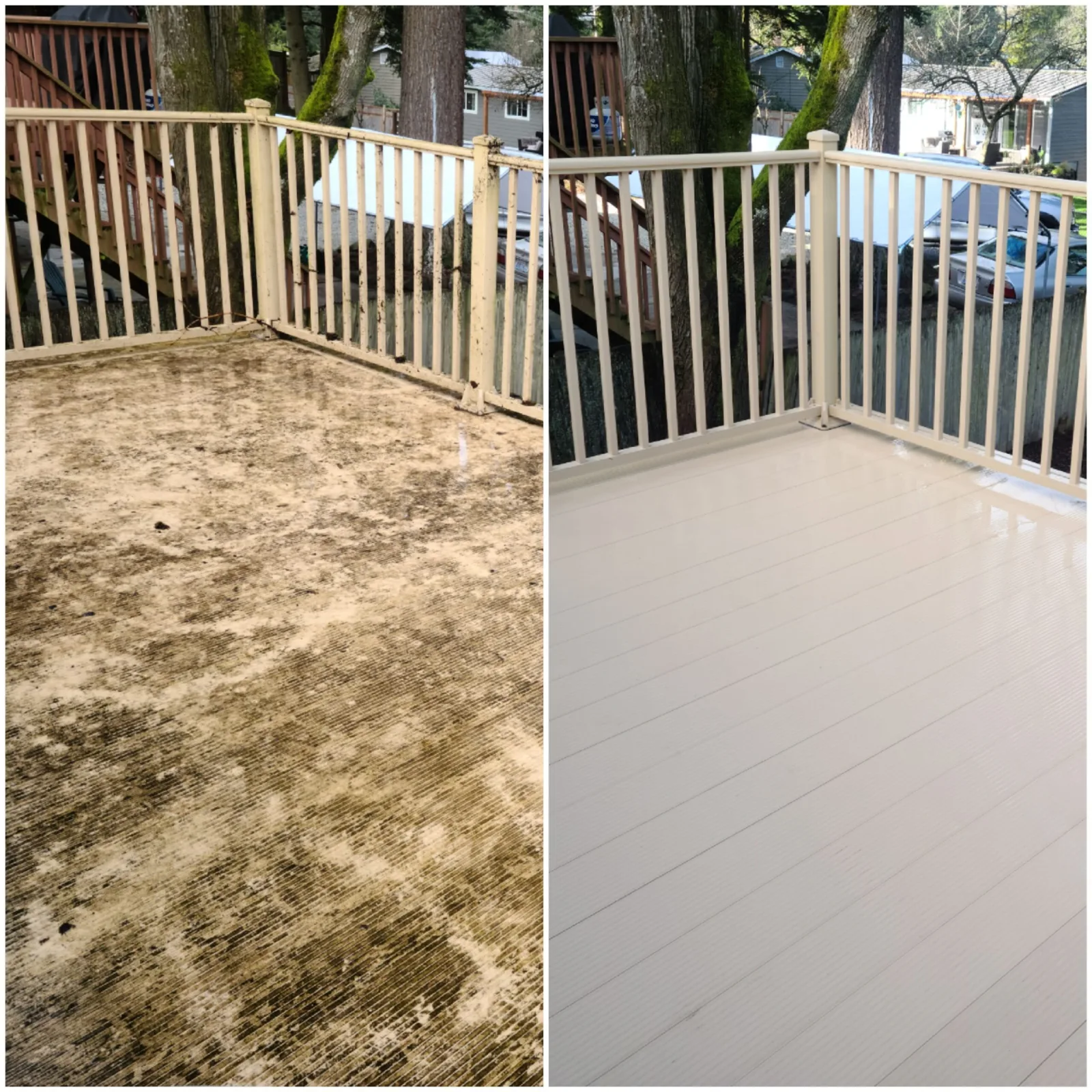
Skipping the brightener is the single most common shortcut in this trade. The deck looks acceptable while wet, dries blotchy, and the sealer applied over it fails within a season or two. If you are comparing quotes, ask specifically whether the price includes a neutralizing brightener. A surprising number do not.
Fences have their own problems
Fences look like vertical decks and behave nothing like them.
The obvious difference is orientation. Cleaning solution runs off a vertical surface quickly, so it has to be applied in a way that maintains dwell without streaking, working bottom to top on application to avoid the clean streaks that run down dirty wood and set as permanent lines.
The less obvious differences matter more. Fences have a neighbor’s side, and a fence restored on one face and untouched on the other looks worse than one left alone. Worth a conversation over the property line before the work is scheduled.
Fence bottoms sit in soil contact and stay wet, so they carry the heaviest growth and sometimes genuine rot that cleaning will reveal rather than fix. Gate hardware, hinges, and latches produce the iron staining the brightener addresses. And landscaping runs right up against most fences, so plant protection during the job is a real part of the work rather than an afterthought.
Patio furniture is a soft wash job
Teak, cedar, acacia, and eucalyptus outdoor furniture responds beautifully to restoration and terribly to pressure.
The pieces are thinner stock than decking, the joinery is often mortise and tenon or doweled, and the fasteners are usually brass or stainless. High pressure loosens joinery, raises grain on thin slats, and drives water into end grain where it stays. Teak in particular develops the silver patina many people like, but when that patina goes uneven and blotchy, restoration brings back the honey color.
The process is the same chemistry at gentler concentrations, applied by hand rather than by machine, with hardware protected and cushions removed and handled separately. It is detail work more than production work.
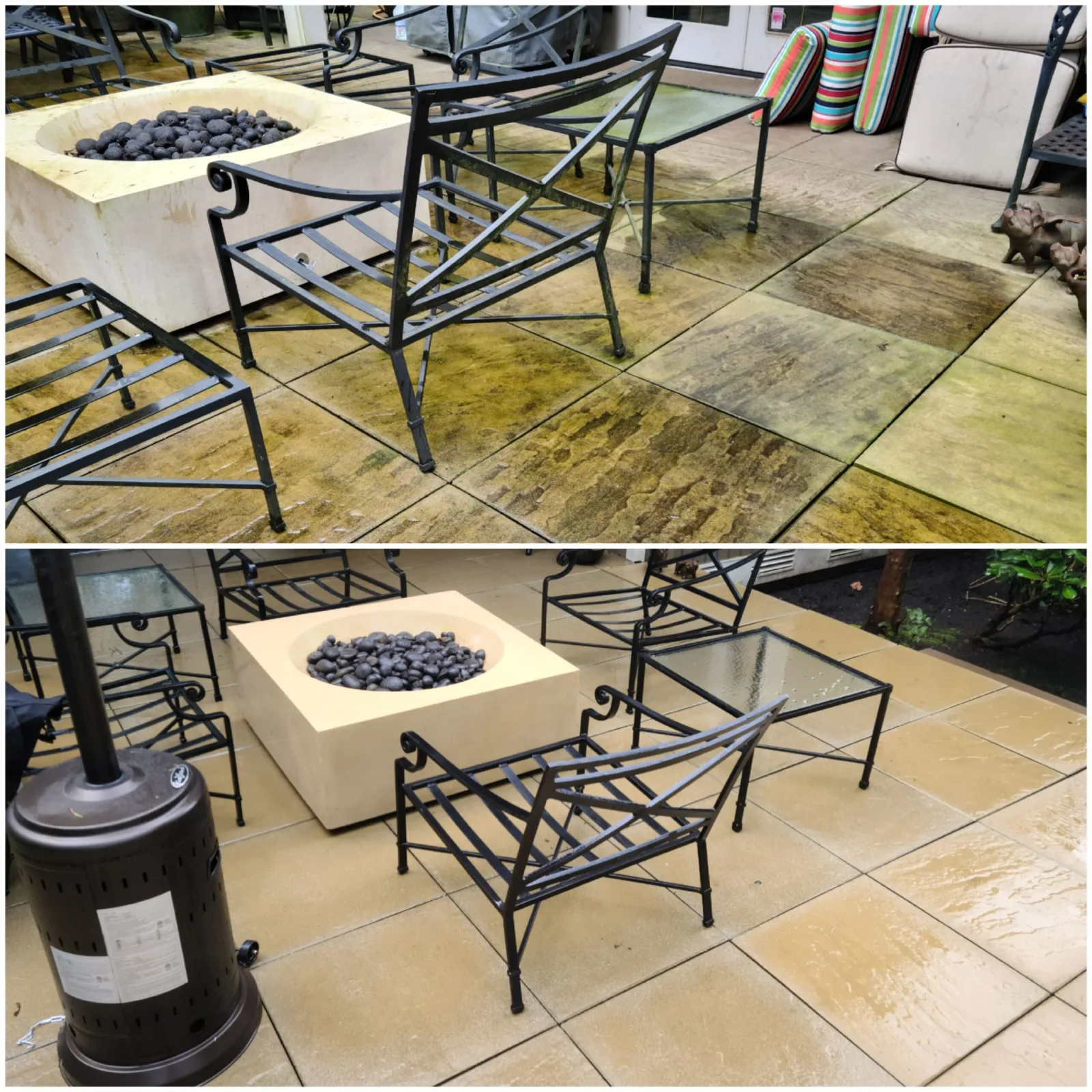
A test patch usually settles it on the spot. Low pressure, the full two-step clean and brighten, and sealing scheduled against the weather window rather than guessed at.
Timing matters in our climate
This is where Pacific Northwest restoration diverges from the generic advice you find online.
Cleaning can happen in most conditions. Sealing cannot. Wood needs to be genuinely dry before a sealer goes on, and depending on the product and the wood, that usually means somewhere between two and five days of dry weather after the wash, with moisture content down in the mid-teens by percentage.
In our region that window is real but limited. Late spring through early fall gives reliable stretches. Attempting a seal in November because the deck finally looks clean generally produces a finish that will not cure properly and will fail.
The practical approach is to schedule the restoration with the seal in mind rather than treating them as separate decisions made months apart. Clean wood left unsealed starts oxidizing again immediately, so a long gap wastes the work.
Temperature matters alongside moisture. Most penetrating sealers want surface temperatures in a moderate range, and a deck in direct August sun can easily exceed it, which is why sealing often happens in the morning or on overcast days rather than in peak sun.
What not to do
Bleach. Sodium hypochlorite whitens the appearance of organic growth without fully killing the root structure, so the green returns quickly. It also degrades lignin, the compound holding wood fiber together, and corrodes fasteners and hardware. A bleached deck looks cleaner and is structurally worse off.
The zero-degree tip. The red tip in a rental kit concentrates the entire output into a point and will carve a visible line into cedar in under a second. There is no application for it on wood.
Do not seal over a deck that was only rinsed. Sealer traps whatever is underneath it. If mildew spores are still in the wood, you have sealed them in, and the finish will discolor from below.
Do not assume gray means replace. Get a small test section cleaned before committing to a rebuild. The difference between a deck that needs restoration and one that needs replacement is structural, meaning soft spots, rot at the joist connections, and failing fasteners, not surface color.
Working with Homefront
We restore decks, fences, and outdoor furniture across Seattle, Bellevue, Kirkland, Bothell, and the Eastside, using low-pressure soft wash and the full two-step clean and brighten process rather than the shortcut version. If sealing is part of the plan, we schedule it against the weather window rather than guessing.
If your wood has gone gray, green, or fuzzy and you want to know whether it is restorable, request a quote and we will take a look. A test patch usually answers the question in about ten minutes.
You can see the areas we cover on our service areas page, and if you are curious about the broader technique side of exterior cleaning, our post on the art of power washing excellence goes deeper on pressure, flow rate, and surface sequencing.
Ready to Transform Your Property?
Get a free, no-obligation power washing quote from Seattle's #1 rated team.