Moss Removal
The one piece of growth on a Pacific Northwest property that does structural damage rather than cosmetic damage. Here is what it is doing, and what actually removes it.
Moss Is Not Sitting On the Surface. It Is In It.
Moss is a shallow-rooted plant, and the reason it matters is where those roots go. On an asphalt roof it does not root into the shingle, it roots into the gap: the horizontal seam where one course overlaps the one below. As the colony thickens it physically wedges that seam open, breaking the sealant bond that keeps wind-driven rain from being pushed up underneath.
On interlocking pavers it roots into the sand-filled joints, and that sand is the only thing transferring load sideways from one paver to its neighbours. Displace it and pavers start to rock, water stops running off the top and starts getting into the bedding layer, and the base begins to wash out.
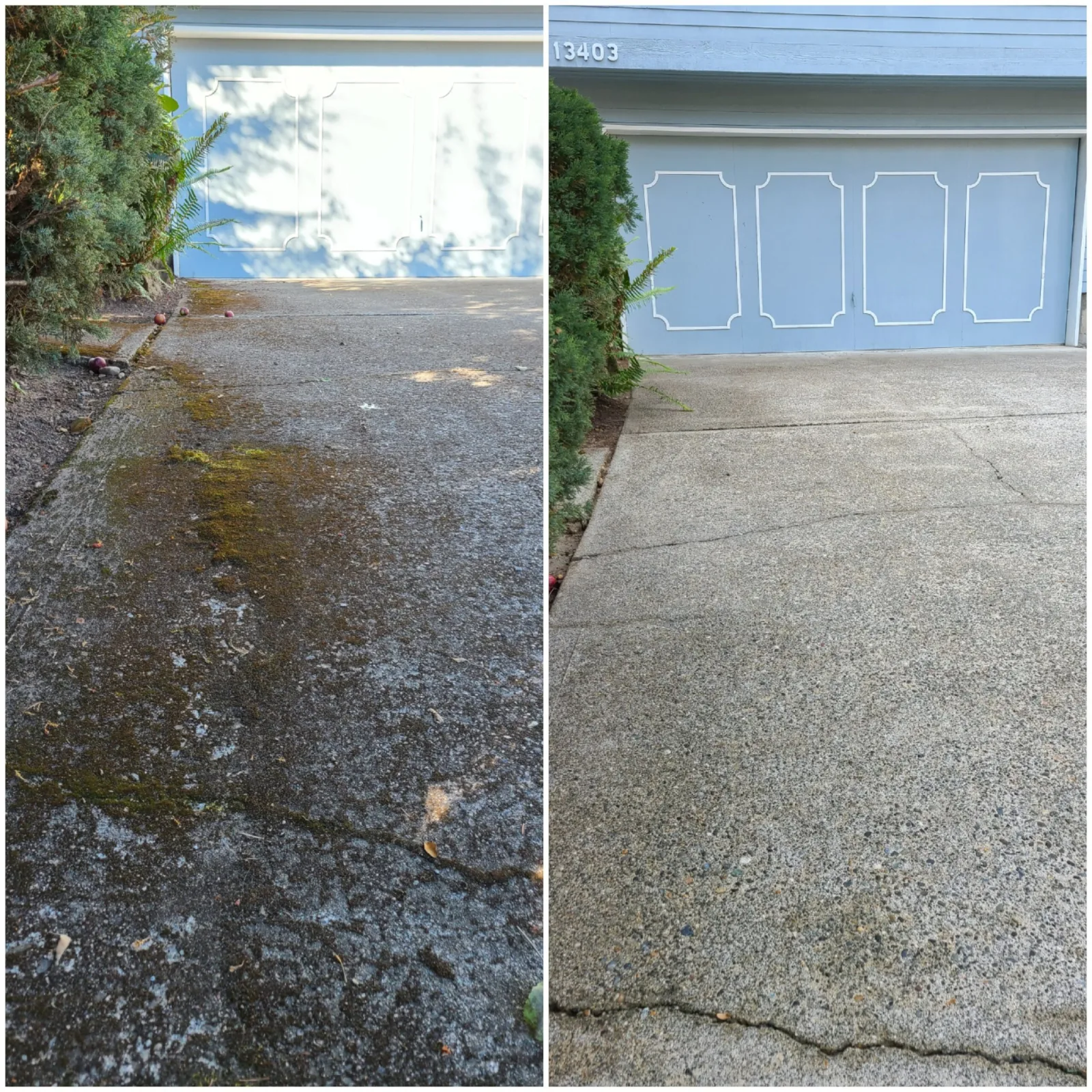
On concrete and wood it is mostly a moisture problem. Moss is extremely good at holding water, so a surface that would normally shed rain and dry out instead stays saturated under every colony, right through the wet season. That is how rot starts in a deck board and how a shaded walkway becomes genuinely dangerous to walk on.
Where it is growing decides who handles it: roof treatment for shingle and shake, paver work where the joints have opened up, wood restoration on decks and fences, and concrete wash and seal on driveways and walkways.
How We Remove It
The method is slower than blasting it off and considerably less dramatic to watch. The surface is still intact afterwards, and the colony does not come straight back.
Clear the Debris First
Needles, leaf litter and branches come off the surface and out of the valleys, gutters and joints before anything else happens. In this region that layer is usually substantial, and it is what feeds the moss. Treating over it is treating the debris rather than the surface.
Identify the Surface and Set the Method
Roof, paver, concrete and wood all take a different approach, and getting this wrong is permanent. Nothing gets a pressure setting chosen for the toughest patch on the property.
Apply Treatment at Low Pressure
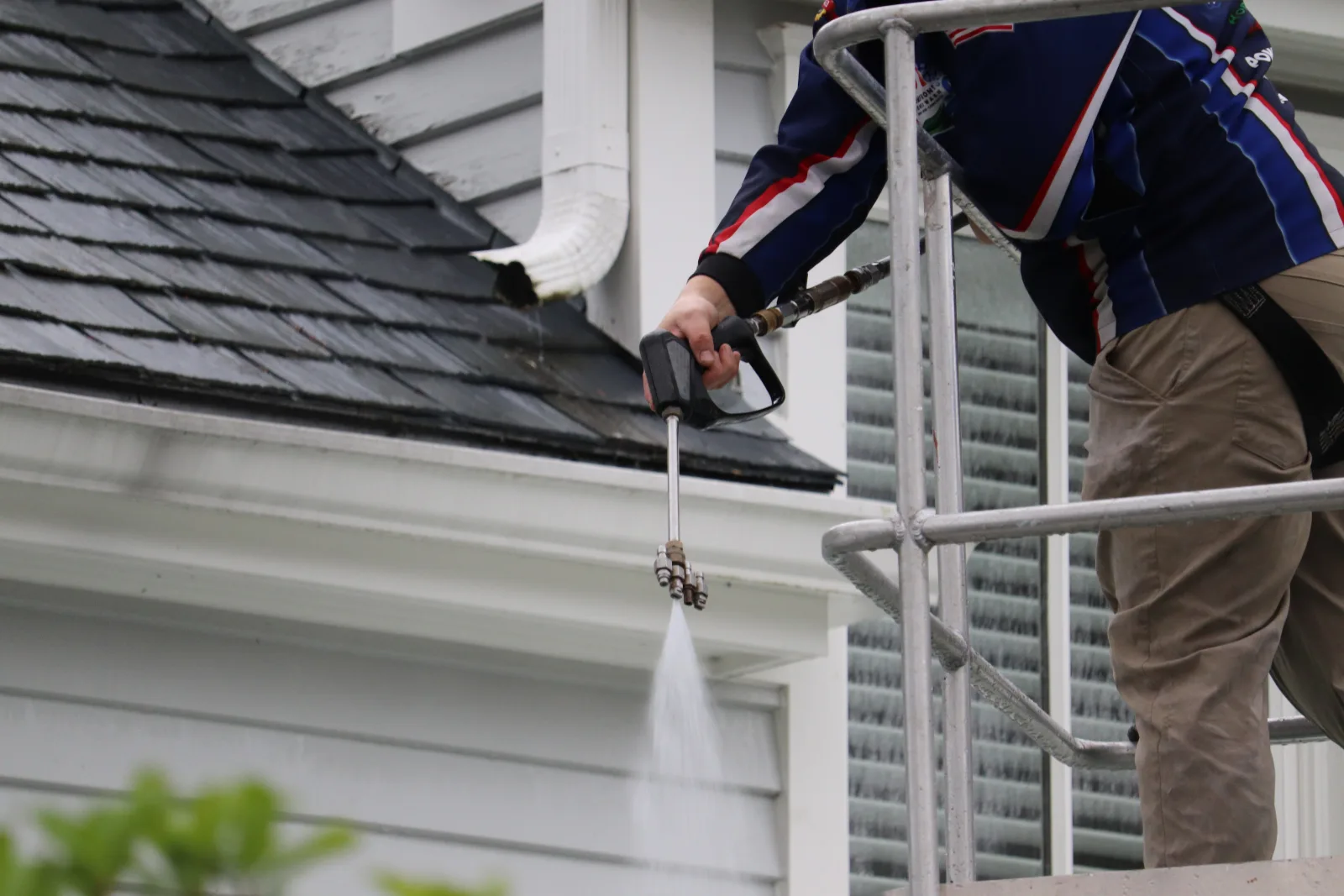
A cleaning solution goes on at a pressure comparable to a garden hose. The solution is what kills the moss, algae and lichen at the root. The water is only carrying it.
Let It Dwell
The chemistry needs contact time. This is the step contractors in a hurry skip, and it is the difference between killing a colony and bleaching it so it looks dead for a month.
Clear the Dead Growth and Rinse Down
Dead moss releases on its own. Heavy accumulations are cleared by hand or soft brush, worked so nothing is driven under a shingle course or into a joint. Surrounding plants are pre-wetted beforehand and rinsed afterwards.
Where We Find It
Moss turns up in the same places on nearly every property we visit, and it is rarely spread evenly.
Roof Seams & North Slopes
In the overlap between shingle courses, worst on north-facing and tree-shaded slopes. Lifts shingle edges and holds water against the deck.
Paver Joints
In the jointing sand between pavers, where it displaces the sand that holds the surface together and lets water into the base.
Shaded Concrete
Along the edges of driveways and walkways where they meet planting beds, and across any stretch that never sees direct sun.
Deck Boards & Fence Rails
In the grain and between boards, holding moisture against wood that is relying on being able to dry out.
Gutters & Valleys
Growing in the debris that collects in the trough, where it blocks flow as effectively as leaf litter does and reseeds the roof above.
Masonry & Retaining Walls
In mortar joints and on shaded stone, often alongside lichen, which bonds chemically and needs different handling again.
Why Treatment Beats Pressure
Pressure Does Not Kill It
Blasting the visible growth off leaves the root structure in the seam or joint. The colony regrows from it, often faster than before.
Roofs Lose Granules
High pressure strips the granule layer off asphalt shingles, taking the roof's UV protection away with the moss.
Pavers Lose Joint Sand
Too much pressure blows out the jointing sand faster than moss ever would, destabilising the surface you were trying to clean.
Wood Raises and Furs
Pressure tears the soft grain out from between the harder rings, leaving a furred surface that holds more moisture than before.
Plants Are Protected
Pre-wetting and rinsing surrounding vegetation is part of the job, not an afterthought once something has already run downhill.
It Stays Gone Longer
Killing the colony at the root, and clearing the debris feeding it, buys considerably more time than knocking the top off.
Frequently Asked Questions
Does killing moss remove it, or does it have to be scraped off?
Both, in sequence. The treatment kills the colony at the root, which is the part that matters, and heavy accumulations are then cleared by hand or with a soft brush. The rest weathers off over the following few weeks. A roof that looks completely bare on the afternoon of service was almost certainly cleaned with force rather than chemistry, and that is how granules end up in the gutter.
Why does moss keep coming back in the same spot?
Because the conditions have not changed and, usually, because the root structure was never killed. Moss establishes where there is shade, retained moisture and an organic layer to feed on. Knocking the visible growth off leaves the roots in the seam or the joint, and the colony regrows from them. Clearing the debris that feeds it, needles and leaf litter above all, does more to slow the return than any product you can buy.
Is moss on a driveway actually a problem, or just ugly?
On a poured slab it is mostly a safety problem, and a real one, since moss and the algae that grows with it are genuinely treacherous underfoot once wet. On pavers it is structural. The moss grows into the sand-filled joints and pushes that sand out, and the joint sand is what stops individual pavers rocking and settling. Enough open joints and a cleaning job becomes a re-laying job.
Will moss treatment hurt my plants?
Not when the work is done properly. Vegetation next to the work area is pre-wetted before anything is applied, which dilutes incidental overspray rather than letting it absorb, and everything is rinsed down afterwards. The risk comes from undiluted product poured straight onto a surface, which then runs downhill into beds and root zones. That is the main reason we would steer you away from doing a driveway yourself with neat bleach.
When is the best time to treat moss in the Seattle area?
Autumn, roughly September through November, is the strongest window. Moss grows hardest in the cool, wet, low-light months and is largely dormant in a dry August, so treating before the heavy growth season means the colony goes into winter dead rather than expanding. Spring is the second-best window. The one rule that is not negotiable: if moss is already lifting shingle edges, the right time is now rather than next season.
Have a question we didn't answer? Call (425) 298-7041or submit a quote request — we respond within 24 hours.
Roof Cleaning Across Seattle & the Eastside
Moss pressure is not evenly spread across our service area. The deeply shaded, heavily treed lots in Woodinville, Sammamish, Issaquah and Snohomish grow it hardest and fastest. Properties close to the water in Kenmore, Medina and Mercer Island hold morning moisture far longer than inland lots, which keeps growth active for more of the year. More open, better-drained ground in Renton, Everett and Newcastle generally buys a longer interval between treatments.
Pick your city for what we usually find locally and the right time to book it.
Don't see your city? We work across the greater Seattle area, roughly an hour out from Kenmore. See the full service area, or call (425) 298-7041 and we'll tell you straight away whether you're in range.
Where Moss Shows Up
Moss removal is usually part of a larger job. These are the pages for the surfaces it affects most:
Think You Have Moss Rather Than Algae?
Send us a photo and we will tell you which one you are looking at and what it needs. If it can wait a season, we will say so. Free quotes across Seattle, Bellevue, Kirkland, Redmond, Sammamish, Bothell, Kenmore, Woodinville and the wider Eastside.
✓ Licensed & Insured✓ 5.0 ⭐ Google Rating✓ Free Quotes in 24hrs✓ 100% Satisfaction Guarantee