Metal Roof vs. Asphalt Shingles: How Cleaning Differs and Why It Matters
The question we get often is some version of: “I had my asphalt roof cleaned a few years ago — can you do the same thing on my new metal roof?” The answer is usually yes, but not the same way, and the distinction matters more than most homeowners realize.
Pacific Northwest roofs of every material share the same problem: our combination of persistent moisture, mild temperatures, and significant tree canopy produces moss, algae, and lichen faster than almost anywhere else in the country. What differs is what those organisms are doing to the specific material underneath them, and what a cleaning can do without making things worse.
What is actually growing on the roof
Before getting into how cleaning differs by material, it is worth being precise about what you are cleaning off, because the organisms look different and behave differently.
Black streaking is almost always Gloeocapsa magma — a cyanobacterium that runs downhill in dark streaks and feeds on the limestone filler used in many shingle and tile products. It is mostly a surface organism and does not root itself into the material the way moss does, but it retains moisture against the roof and creates the conditions for the more destructive growth that follows.
Moss has mass and roots. On an asphalt shingle roof, moss root systems work between shingle layers and physically lift the edges. On a metal roof, moss traps moisture against the coating and against the seams. On tile, it penetrates grout lines and tile joints. The roots are what cause the structural damage — the visible green mat is just the part you can see.
Lichen is the flat gray or pale green crust that looks painted onto the surface. It bonds chemically to the material rather than sitting on it. It is the hardest to remove and the one most likely to leave a ghost mark even after treatment.
All three are present on most Seattle and Eastside roofs that have not been treated in the last two to three years. The question is what the right treatment is for the material underneath.
Asphalt shingles: the granule is the whole game
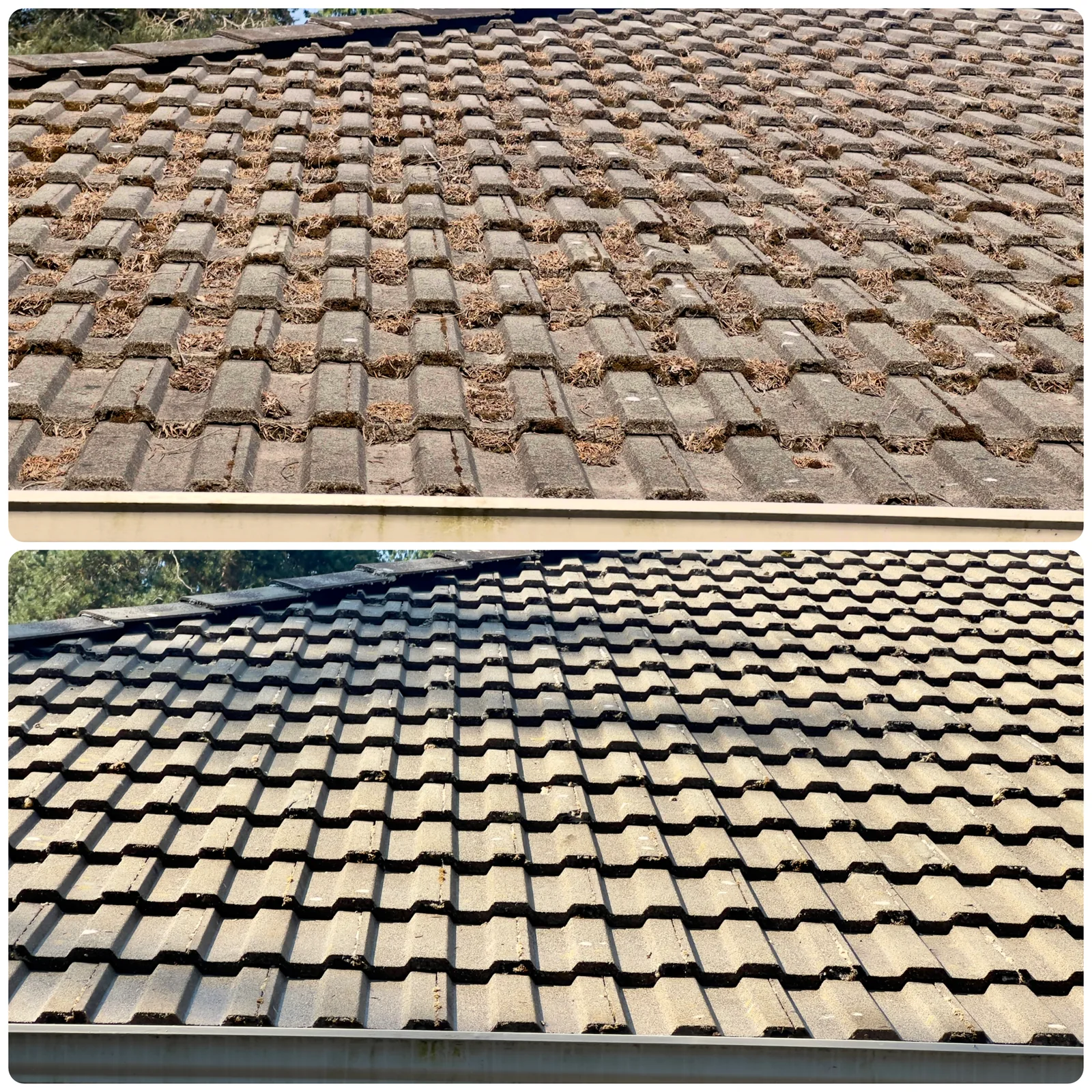
Asphalt architectural shingles have a surface granule — small crushed stone embedded into an asphalt substrate — that does three things: UV protection, color, and a rough texture that helps water shed off the roof. That granule is the functional layer of the shingle, and it is not permanently bonded.
This is why pressure washing an asphalt shingle roof is not a matter of debate. It strips granule. A single pass at typical contractor pressure — 2,000 to 3,500 PSI — removes measurable granule from the shingle surface, reduces its UV protection, and shortens the remaining life of the roof. Most manufacturer warranties include explicit language excluding damage caused by pressure washing above a specified PSI, which is set well below what most contractors use.
The correct method is a soft wash: a cleaning solution applied at low pressure, given adequate dwell time, and rinsed at low pressure. The chemistry is what kills the moss, algae, and lichen at the root and spore level. The low-pressure water is there to rinse what the chemistry already killed. Pressure is not doing the cleaning on a shingle roof — chemistry is.
The other thing soft washing handles that pressure washing does not is regrowth timing. Pressure washing rinses the visible growth off the shingle surface. It does not kill the spores that remain in the granule texture. Those spores re-establish significantly faster than growth killed at the root level by a proper treatment. This is why homeowners who had a roof “power washed” report it looks clean for six months and is green again in a year, while a soft wash treatment holds for two to three years under the same conditions.
Ask them to show you the section of your manufacturer warranty that permits it. Almost none do. The correct answer, every time, is soft wash — chemistry at low pressure. Any contractor who is not clear on this distinction is the wrong contractor for the roof.
Metal roofs: different vulnerabilities, same wrong-method risk
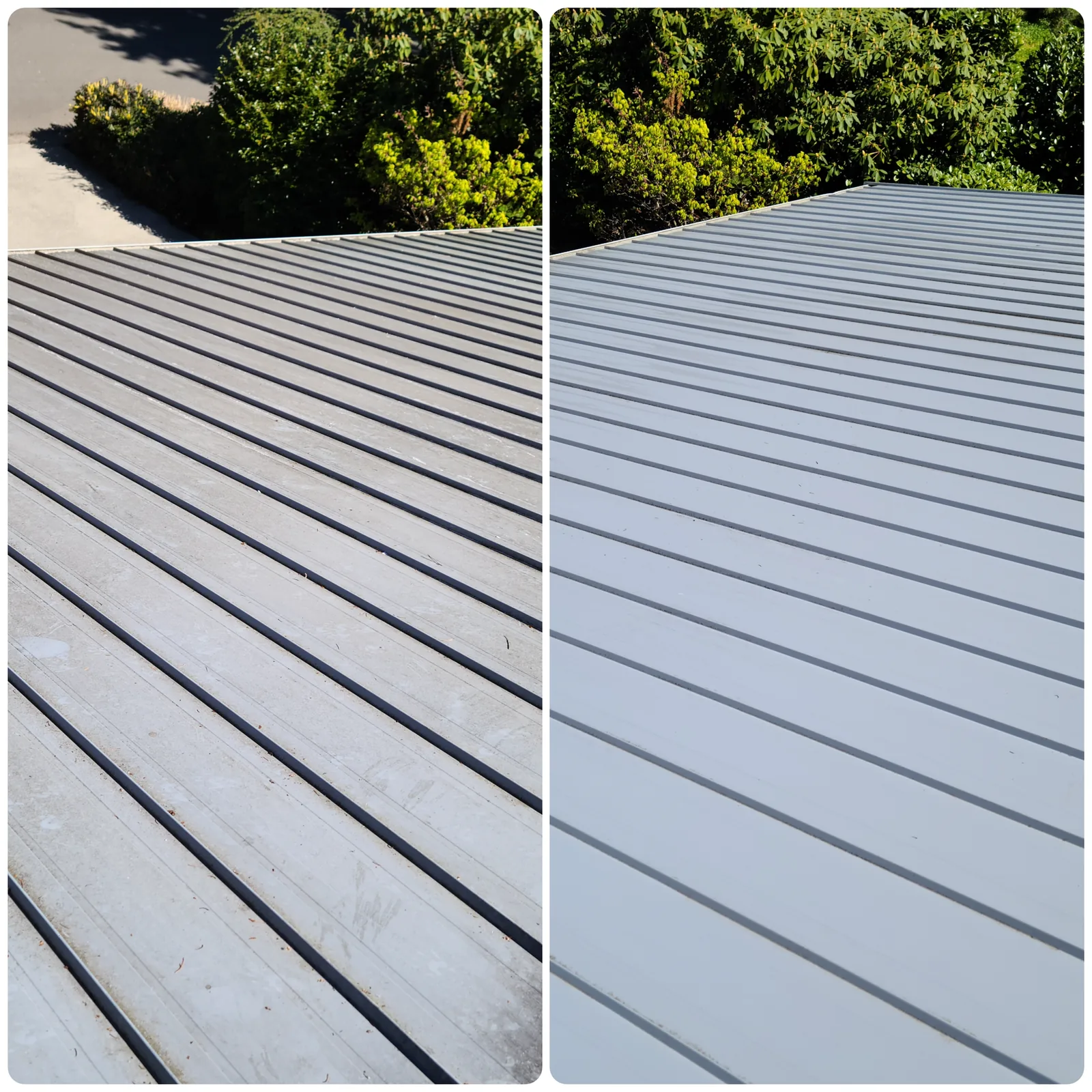
Metal roofing — standing seam, corrugated, exposed fastener panels — is more durable than asphalt in most respects, and it handles higher pressure better than asphalt shingles do. But it has its own vulnerabilities that make the cleaning approach matter.
The coating is what you are protecting. Most residential and commercial metal roofing has a Kynar or similar fluoropolymer coating that provides color, UV resistance, and corrosion protection. High pressure does not strip a Kynar coating the way it strips granule from asphalt, but the right chemistry choices matter. Cleaning solutions that are safe on asphalt are not automatically safe on coated metal. We use chemistry matched to the coating, not a universal roof cleaner applied to everything.
Seams and fasteners are the entry points. Water forced under pressure into seam overlaps or around exposed fasteners on a corrugated or screw-down panel system can compromise the waterproofing over time. This is the same mechanism as the tile roof issue — pressure is not distinguishing between moss and seam. Rinse at low pressure and let the chemistry do the work.
Galvanic corrosion at fasteners. On older metal roofing with steel fasteners, cleaning solutions with the wrong pH can accelerate corrosion at the fastener head. We assess the fastener material before choosing the cleaning chemistry, which is a step that does not apply to asphalt but matters for metal.
The good news: moss and algae do not root into metal the way they root into shingle granule or tile grout. They sit on top of the coating. This means treatment is usually more straightforward on a well-maintained metal roof than on an asphalt roof with established moss — there is less to kill because the roots cannot anchor the same way. The flip side is that neglect shows faster, because metal does not hide streaking the way textured asphalt does.
Composite and tile roofs: the mortar and granule problem
Composite and tile roofing sits between asphalt and metal in terms of durability, but has the most complicated warranty picture of the three.
Composite tiles — architectural profiles, synthetic slate and shake — have the same granule surface as flat asphalt shingles. Pressure washing them has the same effect: granule loss, warranty void, reduced UV protection.
Concrete tile is harder than composite, but tile roofs interlock and overlap rather than seal flat. Water forced under pressure into tile interlaps finds the substrate. Ridge and hip sections on most tile roofs are mortared, and that mortar degrades under pressure over time. The result is a clean-looking roof with compromised waterproofing.
Clay and terra cotta tile is the most delicate. The material itself can crack under thermal shock — meaning cold water under pressure on a hot tile. It cleans beautifully with chemistry and patience and can be permanently damaged by a contractor in a hurry.
| Roof material | Vulnerable to pressure? | Key vulnerability | Correct method |
|---|---|---|---|
| Asphalt architectural shingles | Yes — severely | Granule loss, warranty void | Soft wash only — chemistry and low-pressure rinse |
| Standing seam metal | Somewhat | Coating chemistry sensitivity, seam waterproofing | Low pressure, coating-matched chemistry |
| Corrugated / exposed fastener metal | Somewhat | Fastener intrusion, corrosion risk | Low pressure, fastener-aware chemistry |
| Composite / synthetic tile | Yes — severely | Granule loss same as asphalt | Soft wash only |
| Concrete tile | Moderate risk | Mortar at ridge and hips, water intrusion | Low pressure, mortar inspection after |
| Clay / terra cotta | High risk | Thermal shock cracking, edge brittleness | Gentlest possible — chemistry first |
| Cedar shake | Yes | Water forced under shakes, splits | Low pressure only, with the grain |
Why results last longer with the right method
There is a consistent pattern in the calls we get. Someone had a roof cleaned two or three years ago, it looked fine, and now it is green again and they want it done again. We ask how it was done.
If the answer is pressure washing, the regrowth timeline makes complete sense. Pressure clears the visible growth but leaves viable spores in the texture of the material. The roof re-colonizes from those spores, and the speed of regrowth depends on how quickly the conditions are right again — which in Seattle is usually by the end of the following wet season.
A proper soft wash treatment kills moss, algae, and lichen at the root and spore level. What is left on the surface continues to die and rinse away over the next few rainfall events. The roof does not look its cleanest the day of the treatment the way it does with pressure washing — pressure makes an immediate visual impact. But a properly treated roof holds significantly longer because the biology is actually dead rather than temporarily removed.
This is also why we do not simply quote the same price for every roof of the same size. A roof with five years of established moss requires more chemistry and more dwell time than a roof treated two years ago for a first-time buildup. The price reflects the actual scope, and the result reflects the actual effort.
Trees. A roof under a Douglas fir canopy recolonizes faster than any other single factor — the shade, the drip line, the organic debris in the valleys. Trimming branches back twelve to eighteen inches from the roofline makes a bigger difference to regrowth timing than any post-treatment product, and it is the one thing the homeowner controls.
What a roof inspection during cleaning actually finds
One thing that happens on a properly done roof treatment that does not happen with a pressure wash is an actual look at the roof condition.
Walking a roof to apply chemistry and do a low-pressure rinse requires being on the surface, moving across it methodically. That means we see things. Ridge cap mortar that has cracked and partially separated. Flashing that has lifted. A handful of shingles with granule loss that predates our visit. A valley where debris has built up to the point of holding water.
We do not do roofing contractor repairs — that is a different license and scope. What we do is document clearly what we found and hand that to the homeowner in writing. Some of it is cosmetic. Some of it is the kind of thing a roofer should look at before winter. The homeowner gets to decide what to do with the information, but they have it rather than finding out in a wet February.
Working with Homefront on roof treatment
We clean every roofing material found on Seattle and Eastside homes — asphalt architectural shingles, metal roofing, composite and tile, cedar shake, and low-slope commercial roofing. The method is matched to the material, not set once and applied to everything.
If you are not sure what your roof is made of or what method is appropriate, we will assess it before quoting anything. Free quote, honest scope, same-day response in most cases.
Request a free roof treatment quote or call (425) 298-7041. We serve Seattle, Bellevue, Kirkland, Redmond, Sammamish, Bothell, Kenmore, Woodinville, Issaquah, and the wider Eastside.
Ready to Transform Your Property?
Get a free, no-obligation power washing quote from Seattle's #1 rated team.