Fiber Cement & HardiePlank Cleaning
The board will outlast most of what is around it. The finish on the front and the sealant at the joints are a different story, and those are what cleaning has to protect.
You Are Not Cleaning the Board. You Are Cleaning the Finish.
Fiber cement is genuinely durable, which is exactly why it gets treated roughly. The material will shrug off a lot. The two things on it that will not are the factory-applied colour finish and the sealant holding the joints closed.
That finish is the product you paid a premium for, and it is the thing that keeps the siding looking new for a decade or more. Manufacturers generally point owners toward low-pressure rinsing and a soft brush rather than pressure washing, and that is both the correct way to treat the coating and the simplest way to avoid an argument about a finish warranty later.
The joints matter more. Fiber cement depends on caulk at butt joints, around openings and at trim intersections to keep water out of the wall assembly. Sealant degrades over time, and high-pressure water will locate a failing joint well before anyone standing on the ground does, then push straight through it. Washing this siding carefully is partly about not creating a problem and partly about noticing one.
Like every cladding we work on, it is cleaned by soft washing rather than pressure, and the growth coming off is algae and mildew on the shaded elevations. The siding page compares the materials if you are unsure which you have.
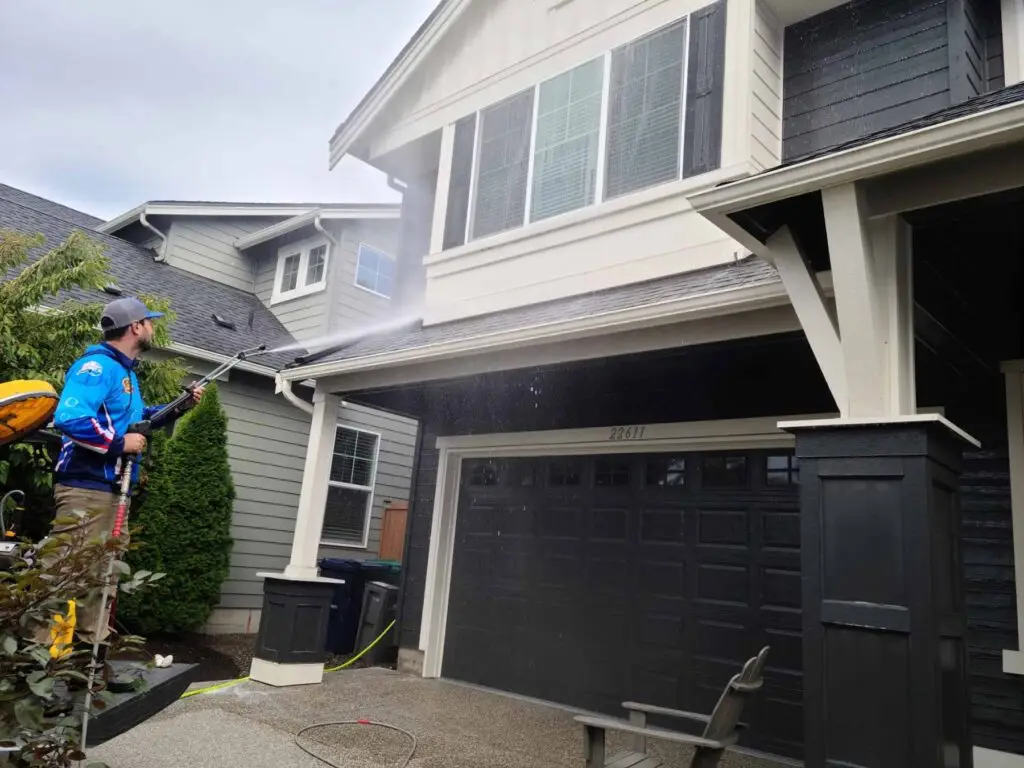
How We Wash Fiber Cement
Gentle on the finish, deliberate around the joints, and honest about what a wash can and cannot fix.
Check the Joints and Finish
We look at the caulk lines, the butt joints and the condition of the coating before anything is applied. Open or failing sealant changes how we work that elevation.
Pre-Wet the Surroundings
Plantings and beds below are wetted so that incidental overspray is diluted rather than absorbed.
Apply Solution at Low Pressure
A correctly diluted cleaning solution at garden-hose pressure. The chemistry removes the mildew and biological staining; pressure contributes nothing here except risk.
Work Around Openings Carefully
Windows, doors and trim intersections get worked deliberately rather than swept past, because those are where water would get in if it were going to.
Rinse and Report
Everything is rinsed, and you get told what we saw. If a run of caulk is going or the finish has reached the end of its life, you want that information now rather than next winter.
What We Address on Fiber Cement
Fiber cement collects less than vinyl or cedar, but what it does collect is predictable.
Mildew & Algae
On north and shaded elevations. The board material makes no difference to what colonises it.
Streaking Below Gutters
Dirty water running the same path repeatedly from joints and sills, which shows clearly on a light finish.
Surface Chalking
Loose chalk and dirt lift off well. Genuine finish fade will not, and we say so rather than overpromising.
Caulk Joints
Cleaned carefully and inspected while we are on them, since they are the water path into the wall.
Soffits, Trim & Eaves
The sheltered areas nothing washes off naturally, cleaned as part of the elevation.
Splash Zone at the Base
The lowest courses, where ground splash keeps the board damp against beds and paths.
Frequently Asked Questions
Fiber cement is tough. Why not pressure wash it?
Because the board is not the vulnerable part, the finish and the joints are. Most fiber cement in this region went up with a factory-applied colour finish, and that finish is the product you actually paid for. Manufacturers generally direct owners toward low-pressure rinsing with a garden hose and a soft brush rather than pressure washing, and following that guidance is also the simplest way to keep a finish warranty intact.
What about the caulk lines?
They are the real weak point. Fiber cement relies on sealant at butt joints, around windows and doors and at trim intersections to keep water out of the wall. Caulk degrades with age and UV, and high-pressure water finds a failing joint long before you do, then goes straight through it. Part of what we do while washing is notice which joints are going and tell you.
My boards look chalky and faded. Can that be cleaned off?
Partly. Surface chalking and dirt come off well and the improvement is usually significant. Genuine fading of the finish is a change in the coating rather than something on top of it, and cleaning will not restore it. If the finish has reached that stage, what you are looking at is a repaint rather than a wash, and we would rather tell you that than take money for a result you will not be happy with.
Does it need doing as often as vinyl?
Usually a little less often, but the same forces apply. The mildew and algae that colonise the north and shaded elevations do not care what the board is made of, they care about moisture and shade. Most fiber cement homes here are comfortable on a yearly or every-other-year wash, with heavily treed lots at the shorter end.
Have a question we didn't answer? Call (425) 298-7041or submit a quote request — we respond within 24 hours.
House Washing Across Seattle & the Eastside
Fiber cement maps almost exactly onto where the region built most recently. Sammamish, Issaquah, Mill Creek, Newcastle and newer pockets of Redmond and Bothell are full of it, most installed within the last fifteen to twenty years, which means the finishes are reaching the age where their condition genuinely varies house to house. Older Seattle and Snohomish neighbourhoods carry far less of it, and what is there is usually a replacement rather than original.
Choose your city for what we typically find locally.
Don't see your city? We work across the greater Seattle area, roughly an hour out from Kenmore. See the full service area, or call (425) 298-7041 and we'll tell you straight away whether you're in range.
Related Pages
Fiber cement is one of several sidings, each handled differently:
Get Your Fiber Cement Washed Properly
Low pressure, careful around the joints, and a straight answer about the finish. Free quotes across Seattle, Bellevue, Kirkland, Redmond, Sammamish, Issaquah, Bothell, Mill Creek, Newcastle and the wider Eastside.
✓ Licensed & Insured✓ 5.0 ⭐ Google Rating✓ Free Quotes in 24hrs✓ 100% Satisfaction Guarantee