Professional Holiday Light Installation in Seattle & Eastside | HPW Guide
You can tell the difference from the street, even if you can’t name it.
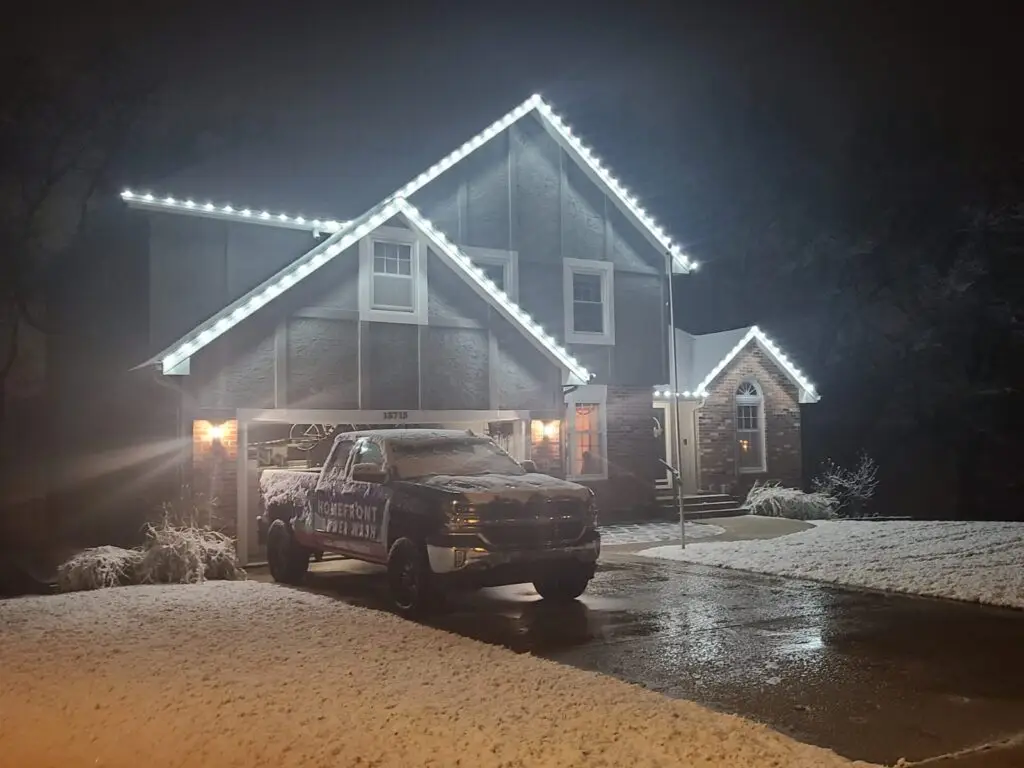
Some houses have a roofline of light that runs perfectly straight, every bulb at the same angle, the spacing identical from one gable to the next. Others have a line that sags between attachment points, bulbs rotating in different directions, a visible extension cord, and one dark section that failed in the first windstorm.
Both took someone’s whole Saturday. Only one of them was worth it.
Here’s what actually accounts for the gap — and why, in the Pacific Northwest specifically, it’s a bigger gap than in most of the country.
The Bulbs Are Not the Same Product
Retail string lights and commercial-grade holiday lighting are different categories that happen to share a shelf metaphor.
A boxed set from a big-box store uses thin-gauge wire with molded bulbs — the bulb and socket are a single sealed unit. When one fails, you can’t replace it. When the wire fails, the run is done. The whole product is engineered to a price point that assumes replacement every year or two.
Commercial-grade systems use C9 and C7 bulbs on SPT-1 or SPT-2 light line with separate, replaceable sockets:
- C9 — the larger bulb, roughly 1¼ inches at the base. This is the classic bold roofline light. Its size is what makes a display read clearly from the street.
- C7 — smaller, about ⅞ inch. Used for detail work: window frames, doorways, railings, and anywhere the viewer is close enough that C9 would overpower.
Because the sockets are separate from the wire, a single failed bulb costs a bulb. And modern LED versions draw roughly 75% less power than incandescent equivalents while producing more consistent color, which matters when you’re running several hundred feet of line off residential circuits.
Custom-Cut Line Is the Actual Difference
This is the part most people don’t know exists.
Retail light strings come in fixed lengths. Your roofline does not come in fixed lengths. So a DIY install involves either doubling up strands where they overlap, leaving a gap where they fall short, or running an awkward loop of excess at the end.
A professional install starts with measuring the property, then cutting light line to the exact dimensions of each run and installing sockets at consistent spacing. Every gable, every eave, every window frame gets a piece of line built for it specifically.
That’s why professionally installed lights look intentional. It isn’t a better product hung the same way — it’s a product built to the house.
It also compounds. Once your lights are cut and labeled to your home, every subsequent year is faster, because the measuring and fabrication is already done. First-year installs take the longest; year three is straightforward.
Attachment: Clips, Not Staples
Never let anyone put a staple through holiday light wire on your house. It’s a puncture through the insulation on an outdoor electrical run, and it’s a hole in your fascia or shingle.
Professional installs use pro-grade clips designed for specific attachment points — shingle clips, gutter clips, ridge clips, and parapet clips. They hold the bulb at a consistent angle, which is the visual detail that separates a crisp line from a messy one, and they come off in January without leaving a mark.
Why PNW Weather Changes the Math
Holiday lighting here faces conditions most of the country doesn’t.
The season runs November through January — the wettest, windiest stretch of the Puget Sound calendar. Lights installed in Seattle, Bellevue, or Sammamish spend eight to ten weeks in sustained rain, with regular wind events and freeze-thaw cycling on the roofline.
That’s genuinely hard on the equipment. Retail-grade string lights fail here at rates that would surprise someone from a drier climate, usually at the connection points, where water finds its way into a molded socket that was never sealed for it.
It also makes the DIY version meaningfully more dangerous. Wet moss on a north-facing roof in November is one of the more treacherous surfaces you’ll encounter, and ladder falls during holiday decorating send thousands of people to emergency rooms every season in this country. We clean these roofs for a living and we still treat them with respect.
Book Earlier Than Feels Necessary
The scheduling reality: installation slots fill from mid-October, and the desirable dates — the weekends right after Thanksgiving — go first.
A rough calendar for the Eastside:
- September–October — quotes and design; best selection of install dates
- Early November — peak installation window
- Late November — still possible, limited dates
- December — largely booked; emergency repairs only
- January — takedown and storage
Returning customers typically get priority scheduling, which combined with the pre-cut line is why the second year of a professional install is both cheaper in effort and easier to book.
Storage Is the Underrated Part
The service most people don’t think to ask about, and the one they appreciate most in year two.
After takedown, lights that are cut and labeled to your home can be stored professionally rather than living in your garage. No tangled bin. No January afternoon spent coiling wet light line. No discovering in November that a section was crushed under a box of tools all year.
It also protects the investment. Commercial-grade LED systems last many seasons when stored properly, and considerably fewer when they don’t.
What a Full-Service Install Includes
For a display to be genuinely hands-off, it needs to cover the whole season:
- Design consultation — assessing roofline, architecture, trees, and the look you’re after
- Installation — custom-cut commercial-grade LED on pro clips
- Mid-season maintenance — because something will eventually go out, and the point of hiring someone is that you don’t get the ladder
- Takedown — cleanly, in January
- Storage — labeled to your home, ready for next year
We install for Christmas, Halloween, Diwali, and Hanukkah, plus commercial properties across the Eastside — retail, office, HOA, and multi-family. Details on each are on our holiday lighting page.
The honest summary: this is one of those services where the professional version isn’t a marginal upgrade over doing it yourself. It’s a different product, installed a different way, that lasts a different length of time — and nobody in your household spends a wet November morning on a ladder.
Book your install before the good dates go. Request a free quote or call (425) 298-7041.
Ready to Transform Your Property?
Get a free, no-obligation power washing quote from Seattle's #1 rated team.